Soldier Warns Police Officer: “You Be Mumu! You Think Wike Will Take Care of Your Family?”…Tension as Military Officer Confronts Policeman Over Abuja Land Dispute

By Dan Opara
A heated confrontation reportedly broke out between a Nigerian military officer, identified as Lieutenant A.M. Yerima, a naval officer acting as commander during the time of the incident, and some police personnel during a recent encounter involving the Minister of the Federal Capital Territory, Chief Barr. Nyesom Ezenwo Wike.
The dispute, which centered on a contested parcel of land in Abuja, has since stirred widespread reactions across the country.
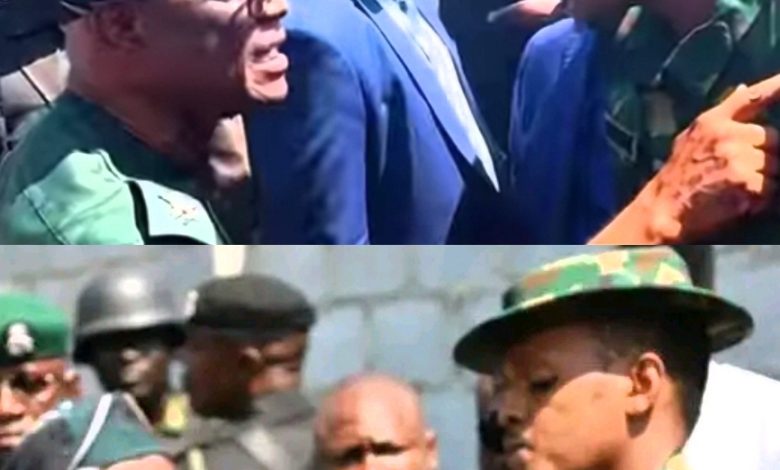
ThePressman Newspaper gathered from viral video footage circulating on various social media platforms that the altercation occurred on Tuesday, November 11, 2025, in Abuja, after a police team attached to the FCT Administration allegedly attempted to chase away the FCT Minister from the disputed land site.
The situation took an unexpected turn when a certain police officer stepped in to defend the Minister, only to be sharply rebuked by Lieutenant Yerima, who insisted that Wike should not proceed further into the land.
In the trending footage, the visibly agitated soldier was seen and heard shouting at the police inspector, saying:
“You be mumu! You think Wike will take care of your family? If anything happens to you now, your family will suffer!”
The confrontation, which has since attracted nationwide attention, reignited debates on the overlapping roles of Nigeria’s security agencies, particularly the growing involvement of the military in civil and land-related matters.
While some observers have commended the soldier for his firmness and courage in halting the Minister’s advance, others have criticized what they describe as an overreach by the military in purely civil affairs, arguing that such actions violate constitutional boundaries.
According to public commentators, issues such as land disputes, property demolitions, and enforcement of development regulations fall strictly under the jurisdiction of the Nigeria Police Force, the Nigeria Security and Civil Defence Corps, and other paramilitary bodies, not the military.
A concerned citizen who reacted to the incident stated:
“Yes, the soldier handled the issue in a bold and decisive manner.
But to me, a soldier has no right to protect private property.
That’s a civil responsibility. Soldiers are trained to defend the nation against external threats, not to guard land or buildings.
The military has gradually started doing police duty.”
A review of constitutional provisions shows that under Section 217(2) of the 1999 Constitution of the Federal Republic of Nigeria (as amended), the Armed Forces of Nigeria are established to:
(a) defend Nigeria from external aggression;
(b) maintain its territorial integrity and secure its borders from violation on land, sea, or air;
(c) suppress insurrection and act in aid of civil authorities when called upon to do so by the President; and
(d) perform such other functions as may be prescribed by an Act of the National Assembly.
This section clearly confines the duties of the military to national defense and internal security support, and only when officially directed by the President.
Therefore, a serving military officer’s direct involvement in a civil land dispute without formal authorization constitutes an action beyond constitutional powers.
On the other hand, Sections 214 and 215 of the same Constitution empower the Nigeria Police Force to maintain law and order, protect lives and property, and enforce laws within the country, responsibilities that cover land protection, enforcement of demolition orders, and civil disturbances.
Similarly, under the Federal Capital Territory Act of 1976, the FCT Minister serves as the Chief Executive Officer of the Territory, with full authority over land allocation, urban planning, and development control.
Hence, Chief Nyesom Wike, as FCT Minister, acted within his administrative and legal capacity if the visit was part of his official duties.
Legal analysts, however, argue that Lieutenant Yerima’s confrontation of the Minister could be regarded as ultra vires, since the Constitution does not empower military personnel to interfere in civilian administrative functions except upon presidential directive.
The incident has consequently renewed public calls for a clearer demarcation of responsibilities among security agencies to prevent unnecessary clashes, preserve professionalism, and uphold the rule of law within Nigeria’s security structure.
As at the time of filing this report, both the Ministry of Defence and the Nigeria Police Force had yet to issue official statements on the incident.
Meanwhile, during the heated exchange, Lieutenant A.M Yerima was heard firmly asserting his position, saying:
“I’m not a fool, Sir.
I am an officer, I have integrity.
I am a commissioned officer, Sir.
You can’t shut me up.
I am not a fool, Sir.
I take orders only from my superiors.
You can’t call me a fool.”
These were the emphatic words of Lieutenant Yerima, reflecting his strong defense of his professional dignity and command responsibility during the confrontation.