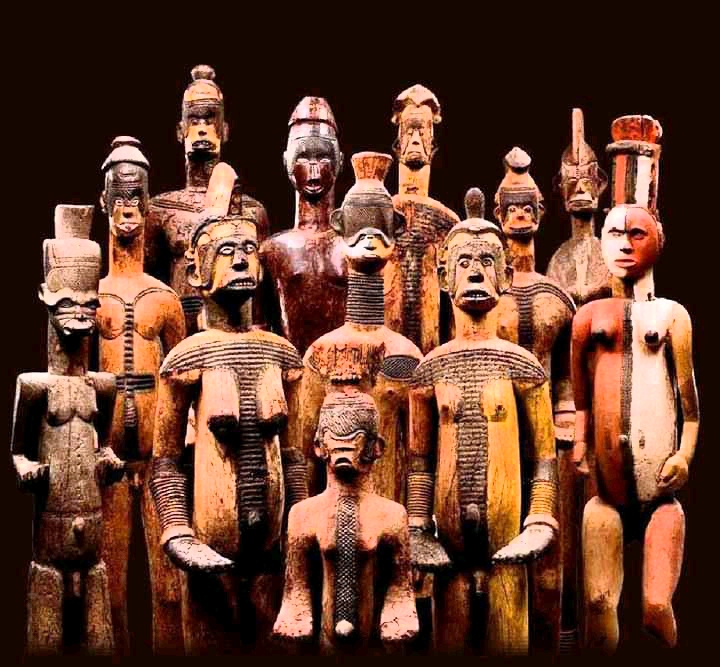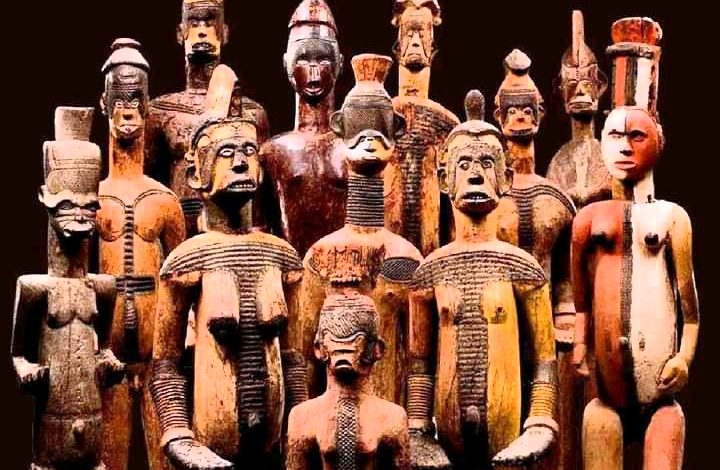
The terms Arusi and Agbara often holds significant meanings in Igbo traditional religion and cosmology, yet they are always misunderstood or used interchangeably.
A closer examination reveals their distinct roles and cultural implications.
What is Arusi?
Arusi refers to effigies or physical representations of spiritual entities, often labeled as “juju” by outsiders.
These are contractual spirits invoked to perform specific actions or favors for their devotees.
The word Arusi is derived from the phrase Aru-nsi, meaning “to work magic” or “a magical act.”
Variations of the term include Alusi, Arushi, and others depending on dialectal differences.
In Igbo tradition, Arusi are not deities in the strict sense but are instead custodial spirits created to protect specific locations or fulfill particular functions.
They serve their owners, who, in turn, owe them service and offerings.
These spirits are typically installed using libations and sacrifices, including, historically, human offerings in some instances.
A notable characteristic of Arusi is their diversity.
Each community, family, or individual can have a unique Arusi, making it impossible to catalog all the Arusi within Igbo culture.
Some were bought and brought home by travelers, leading to the prominence of certain Arusi in different regions.
While there are countless Arusi, some transcend local boundaries, such as Agwu-nsi, Njoku Ji (and his wife, Ifejoku), Ikenga, and Ofo.
What is Agbara?
Agbara comes from an ancient Proto-Kwa word meaning “power” or “authority.”
It refers to nature divinities or principalities that preside over geographic areas.
Examples include Ala (the Earth goddess), Igwe (sky divinity), and Oshimiri (water spirits).
These spirits are often associated with the elemental forces governing creation and balance in the universe.
Unlike Arusi, Agbara is not tied to a physical representation but is instead understood as a manifestation of spiritual power.
The term is more prevalent among Southern Igbo communities, whereas Arusi is more widely used in other regions.
Key Differences Between Arusi and Agbara
While the terms are often used interchangeably, they serve different purposes:
Arusi typically refers to physical idols or effigies representing specific spirits.
Agbara denotes the abstract power, authority, or divinity governing nature or specific territories.
The Supreme Deity and Igbo Cosmology
The Igbo do not have a fixed pantheon of gods like the Yoruba Orisha or Greco-Roman deities.
Instead, the Igbo recognize one Supreme Deity, Chukwu (also called Oseburuwa, Orisa, Obasi, etc.), who manifests through four principles:
- Chi-ukwu – the great spirit.
- Okike/Eke – creation or the creative principle.
- Anyanwu – the sun or life-giving force.
- Agbara – power or authority.
Under Chukwu, contract spirits (Arusi) serve specific functions, while elemental divinities (Agbara) govern natural forces and geographical domains.
Diversity of Arusi and Agbara
The diversity of Arusi reflects the unique needs and histories of the Igbo people. Some notable spirits include:
Amadioha – associated with justice and thunder.
Ekwensu – a complex spirit often misunderstood as a devil.
Ogwugwu, Arobinagu, Igbudu, and others tied to specific regions or functions.
The Chief Priest or Custodian of an Agbara or Arusi is referred to as Onye Isi Ala, Onye Isi Agbara or Onye Eze.
Failure to honor one’s obligations to these spirits often results in misfortune or even death.
The Role of Nri in Proliferating Arusi Supposed Cults
The Nri kingdom in Anambra State of Nigeria is credited with spreading many of these spiritual practices and supposed cults across Igboland.
Their influence has helped and is helping in reshaping the cosmological and religious landscape of the Igbo people, ensuring that the principles of Arusi and Agbara remained central to community life.
In summary, understanding Arusi and Agbara requires an appreciation of the dynamic and localized nature of Igbo spirituality.
These concepts are not fixed but adapt to the unique socio-cultural and spiritual needs of the Igbo people.
In the same vein, in the cosmology of Igbo land, Arụsị (deities) and Agbàrà (spiritual forces or powerful spirits) holds significant roles in the traditional belief system.
These concepts are deeply rooted in the Igbo worldview, which sees life as interconnected between the spiritual and physical realms.
Here is an explanation:
- Arụsị (Deities or Divinities):
Definition: Arụsị refers to deities or sacred entities that serve as intermediaries between Chukwu (the Supreme Being) and humans.
Each Arụsị governs specific aspects of life, nature, and morality.
Examples:
Amadioha: The god of Thunder and Justice.
Ala (Ani): The goddess of the Earth, Fertility, Morality, and Harvest.
Ikenga: The deity of personal achievement, success, and strength.
Role: Arụsị are revered, worshiped, and consulted for guidance, blessings, and protection.
They enforce societal norms and are believed to punish wrongdoing or immorality.
- Agbàrà (Spiritual Forces/Powerful Spirits):
Definition: Agbàrà refers to mystical forces or spirits that inhabit sacred groves, rivers, trees, or specific locations.
These spirits can be malevolent, benevolent, or neutral, depending on their nature and the intention of the individuals invoking them.
Connection to Arụsị: While Arụsị are more structured and often personified, Agbàrà represents raw, untamed spiritual energy or beings with specialized powers.
Roles and Functions:
Protecting communities and individuals from harm.
Acting as oracles or conduits for divination (e.g., through dibia afa, diviners).
Granting powers to traditional priests or custodians.
Cosmological Significance in Igbo Land:
Balance and Harmony: The Igbo cosmology emphasizes balance between the spiritual and physical worlds.
Arụsị and Agbàrà are essential to maintaining this harmony.
Moral Code: Through fear of punishment and reverence, Arụsị and Agbàrà help enforce ethical behavior.
For instance, the Earth goddess (Ala) is central to upholding truth, purity, and justice.
Sacred Sites: Shrines, forests, rivers, and hills are often dedicated to specific Arụsị or inhabited by Agbàrà.
These spaces are respected as holy and are sites for rituals, offerings, and prayers.
Divination and Problem-Solving: The Agbàrà communicate through divination to guide people in resolving disputes, addressing illnesses, or overcoming challenges.
Key Practices:
Worship and Sacrifice: People make offerings (e.g., yams, kola nuts, or animals) to appease Arụsị or Agbàrà.
Festivals and Ceremonies: Rituals celebrating deities (e.g., Iri Ji Festival honoring Ala) reinforce community bonds and gratitude to the divine.
Taboos and Laws: Violating rules associated with a deity (e.g., desecrating sacred land) is met with punishment, emphasizing the deities’ authority.
In Conclusion:
In Igbo cosmology, Arụsị and Agbàrà embody the spiritual forces that govern life and the universe.
They bridge the gap between the material and metaphysical worlds, guiding, protecting, and sometimes disciplining the people.
Understanding their roles highlights the deeply spiritual and interconnected worldview of the Igbo people, where every aspect of life is infused with divine significance.
Culled By Dan Opara (Danjay), Journalist, from ThePressman Newspaper.