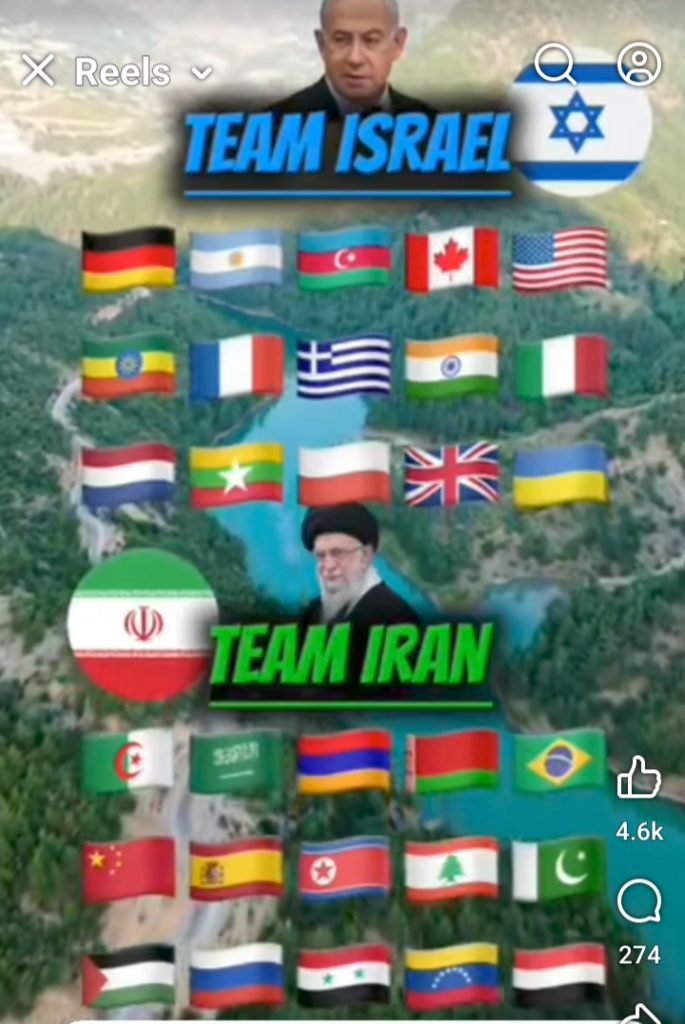
A widely circulated image captures a symbolic representation of the current geopolitical divide surrounding the ongoing tensions between Israel and Iran.
Presented in a visually engaging format, the illustration segregates two opposing blocs under the banners of “Team Israel” and “Team Iran,” each aligned with a cluster of national flags representing their presumed allies or sympathizers in the evolving global political landscape.
On one side, Team Israel is visually anchored by the Israeli national flag and is symbolically led by a figure resembling Prime Minister Benjamin Netanyahu, a long-standing and influential figure in Israeli politics.
Surrounding Israel are the flags of several Western and allied nations, including the United States, Germany, Argentina, and Canada.
This grouping appears to depict the Western-aligned coalition that has historically maintained diplomatic, military, and intelligence cooperation with Israel, particularly on issues concerning regional security, counter-terrorism, and opposition to Iran’s nuclear ambitions.
The placement of the United States flag is especially prominent, underscoring Washington’s pivotal role as Israel’s most steadfast ally.
The inclusion of Germany reflects strong historical and defense ties, while Canada and Argentina suggest a broader network of nations that support Israel diplomatically or ideologically, particularly within international forums like the United Nations and beyond.
On the opposite end of the graphic lies Team Iran, symbolized by the Iranian national flag and personified by a figure bearing a close resemblance to Ayatollah Ali Khamenei, the Supreme Leader of the Islamic Republic of Iran.
The flags aligned with Iran include those of Syria, Russia, China, and notably, Saudi Arabia.
This cluster reflects a different geopolitical orientation—one that is largely anti-Western, critical of American influence in the Middle East, and in some cases, united by strategic, economic, or ideological interests.
The presence of Syria emphasizes the close military cooperation and shared opposition to Western and Israeli influence in the region, while Russia and China highlight Iran’s growing alignment with major global powers that challenge the unipolar dominance of the United States.
The inclusion of Saudi Arabia, however, is controversial and potentially misleading, given the complex and historically antagonistic relationship between Riyadh and Tehran.
Though recent diplomatic thawing has occurred—especially through China-brokered normalization talks—Saudi Arabia’s inclusion may reflect a speculative or emerging axis rather than an established alliance.
This image, while oversimplified, reflects the polarizing dynamics that shape the Middle East’s current geopolitical landscape.
It symbolizes the ideological, military, and strategic divisions that have intensified over recent years, fueled by conflicts in Syria, disputes over Iran’s nuclear program, regional proxy wars, and global power competition involving the U.S., Russia, and China.
The portrayal of world leaders above each team not only personalizes the conflict but also reinforces the narrative of leadership-driven foreign policy.
It’s a visual that captures the essence of modern geopolitical rivalry, reduced to a dichotomous “team” structure that, while lacking nuance, resonates strongly in the digital age of memes, viral content, and simplified political commentary.