Nigeria’s Senate Electoral Bill: A Masterclass in Political Liability, Self-Sabotage, Okadigbo Writes

Nigeria’s Senate Electoral Bill has become yet another stark reminder that electoral reform in the country is treated less as a democratic obligation and more as a battlefield where entrenched interests struggle to preserve power at all costs.
What ought to have been a bold legislative framework to deepen democracy has instead revealed a troubling pattern of manipulation, delay, and governance driven by bad faith.
At the centre of the controversy is a Senate that appears to legislate with one eye on constitutional responsibility and both eyes fixed firmly on the next election cycle.
Self-Interest Above National Interest
The most corrosive challenge confronting the Electoral Bill is the glaring conflict of interest embedded in its handling.
Senators are not detached arbiters of reform; they are direct participants in the electoral contest.
Provisions relating to electronic transmission of results, independent candidacy, campaign finance regulation, and party primaries have repeatedly been diluted, delayed, or undermined.
The concern, critics argue, is not that these clauses are defective, but that they threaten incumbent advantage.
Every proposed reform appears to face one underlying question: Will this diminish our chances of returning to office in 2027?
Where the answer suggests reduced political advantage, such provisions are either stalled, weakened, or discarded altogether.
Rather than producing clear and enforceable legislation, the bill is said to reflect a pattern of deliberate vagueness.
Key sections are drafted with language open to broad interpretation, creating potential loopholes for exploitation.
This is not mere legislative oversight. It is viewed as strategic ambiguity, crafted to provide room for manoeuvre when electoral disputes arise.
In a system already burdened by institutional fragility, ambiguity is not neutral; it is dangerous.
It opens pathways for manipulation and undermines public confidence in the integrity of the electoral process.
One of the most contentious aspects of the bill is the Senate’s resistance to fully entrenching electronic transmission and digital collation of results.
In an era defined by technological advancement, such resistance raises fundamental questions.
Electronic systems reduce opportunities for ballot tampering, result alteration, and human interference, precisely the vulnerabilities that have historically plagued Nigeria’s elections.
Opposition to technological reform, therefore, is widely interpreted not as a logistical concern but as reluctance to relinquish control over mechanisms that enable manipulation.
Transparency threatens entrenched political advantage, and that threat appears to shape legislative hesitation.
Another significant shortcoming of the bill is its failure to provide robust protection for the independence of electoral institutions.
Without strong legal guarantees, bodies such as the Independent National Electoral Commission (INEC) and security agencies remain susceptible to executive pressure, budgetary leverage, and post-election intimidation.
A legislature committed to democratic consolidation would prioritise institutional autonomy.
Critics contend that what is emerging instead is a framework that preserves institutional obedience rather than independence.
Civil society organisations, youth groups, election observers, and ordinary voters often find themselves marginalised in the legislative process.
Public hearings are frequently perceived as procedural formalities rather than genuine consultations.
The outcome is a bill shaped within elite chambers, disconnected from the lived realities of citizens who confront electoral violence, vote-buying, and disenfranchisement.
Such detachment reinforces voter apathy and strengthens the perception that elections are arrangements among political elites rather than expressions of popular will.
Perhaps the most cynical dimension of the process is the strategic use of delay. Electoral reforms are frequently postponed until implementation becomes impractical ahead of scheduled elections.
Subsequently, logistical constraints are cited as justification for maintaining the status quo.
This cycle benefits incumbents by preserving familiar structures long enough to secure political advantage.
In this context, delay is not administrative dysfunction; it is a calculated political tool.
The obstacles facing Nigeria’s Senate Electoral Bill are not merely technical challenges; they are fundamentally moral and political.
The central question is whether the legislature is prepared to prioritise democratic integrity over electoral self-preservation.
Every diluted provision, every postponed decision, and every ambiguous clause contributes to the perception of a political class uneasy with genuinely free, fair, and competitive elections.
Until lawmakers conclude that the health of Nigeria’s democracy outweighs the security of their individual seats, electoral reform risks remaining symbolic rather than transformative.
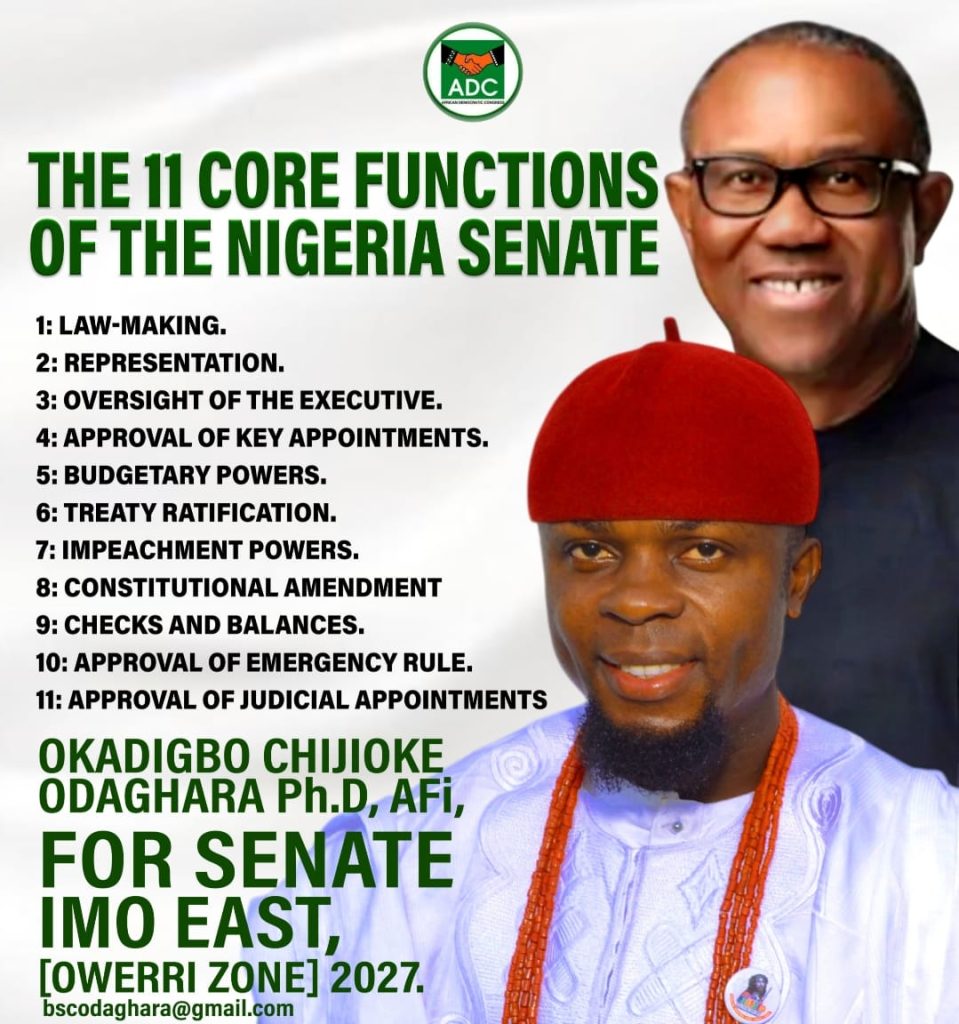
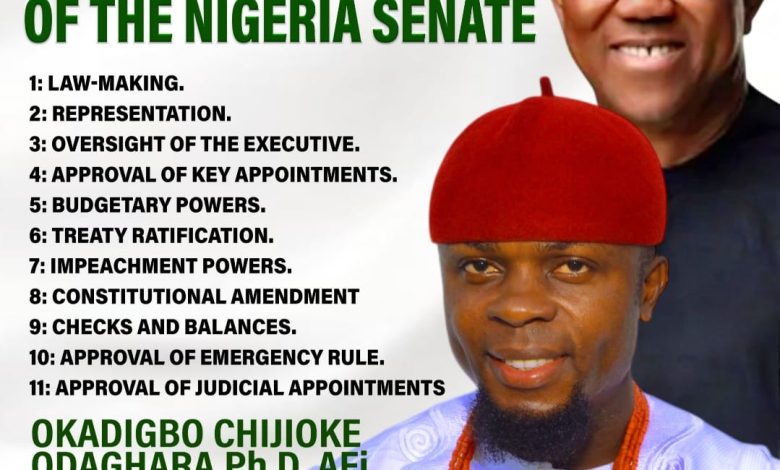
Written by Okadigbo Chijioke Odaghara, Ph.D, AFi , the ADC Senatorial Candidate for Imo East (Owerri Zone) 2023, aspiring for the same position ahead of 2027.