
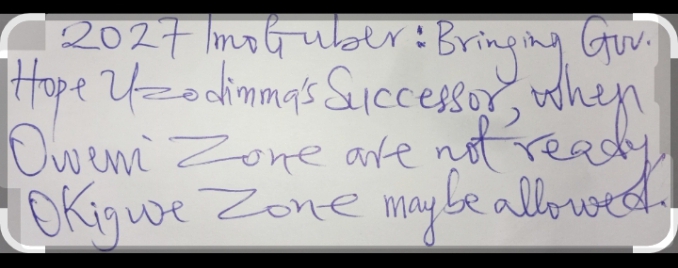
2027 Imo Guber: Orlu Zone Taken, But When Owerri Zone Not Ready, Okigwe Zone May Be Allowed To Produce Uzodimma’s Successor

By Dan Opara
As the 2027 governorship election in Imo State gradually draws near, political discourse across the state has once again returned to the sensitive and recurring question of zoning and power rotation among the three senatorial zones, Owerri, Okigwe, and Orlu.
By every principle of equity, justice, and fairness, it is unarguably the rightful turn of the Owerri Zone extraction to produce the next governor of Imo State.
The people of Orlu Zone have already held sway in the governance of the state for over twenty-six years since the return of democratic rule in 1999, while the Okigwe Zone has also had its share with one of its sons serving a full four-year tenure.
Unfortunately, the Owerri Zone has remained the most marginalized in the political leadership of the state, having only produced a governor who served for a mere seven months before his mandate was truncated by the Supreme Court of Nigeria.
That historic ruling, delivered on January 14, 2020, ushered in the incumbent governor, Senator Hope Uzodimma, who was sworn in the following day, January 15, 2020.
Interestingly, Governor Uzodimma himself has repeatedly acknowledged that power should rotate to the Owerri Zone by 2027 in the spirit of fairness and inclusiveness.
However, despite this moral advantage and political goodwill, Owerri Zone appears disorganized, divided, and unprepared to seize the opportunity that history is presenting to them.
There seems to be a lack of strategic unity and coordinated vision among political stakeholders, leaders, and opinion moulders within the zone.
The absence of consensus and internal cohesion could make it difficult for the zone to produce a strong, credible, and widely accepted candidate capable of commanding broad support across party lines and regions of the state.
If this indecision and political disunity persist, the pendulum of opportunity may very well swing toward the Okigwe Zone, which might be considered as an acceptable alternative by the political class and power brokers who are more concerned with stability and continuity than sentiment.
Imo State today stands at a defining moment.
The next governorship election, expected to take place in late 2027, will shape the future direction of the state for another generation.
While the Orlu Zone has already had its fair share of power, and Okigwe Zone has had a turn, it is now time for Owerri Zone to awaken from political slumber and claim its rightful position through preparedness, strategy, and unity of purpose.
The people of Owerri Zone must not only demand fairness, but must also demonstrate readiness.
They must rise collectively to identify, present, and rally behind at least three popularly accepted figures, political juggernauts, technocrats, and visionary leaders, who, when elected, can transform Imo State into a model of good governance, economic development, and peace.
This is not the time for division or complacency.
It is the time for the Owerri Zone to build bridges, strengthen alliances, and strategically position itself to produce a governor who will make Imo State a heaven of prosperity, unity, and hope for all its citizens.
If Owerri Zone fails to get its act together now, then history may once again pass it by, and the political space could tilt in favor of the Okigwe Zone, which seems quietly waiting in the wings for the next big chance.
The message is clear: Owerri Zone must wake up now, or risk losing 2027 to another zone once again.




