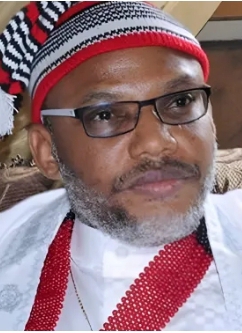
The Federal High Court (FHC) in Abuja has issued a stern warning to the Director-General of the State Security Service (SSS), Adeola Ajayi, threatening imprisonment for his agency’s refusal to grant lawyers access to Mazi Nnamdi Kanu, the leader of the Indigenous People of Biafra (IPOB), who is currently facing terrorism charges.
Kanu has been detained since June 2021, following his controversial repatriation to Nigeria from Kenya. His legal team has repeatedly accused the SSS of obstructing their access to him. In a recent notice, the FHC emphasized that further denial of access would constitute contempt of court, potentially leading to Mr. Ajayi’s imprisonment.
Judge Binta Nyako, on May 20, had explicitly ordered the SSS to permit Kanu to receive visitors on Mondays, Wednesdays, and Fridays. The court reiterated this directive in a notice issued on Friday, warning that noncompliance would result in legal repercussions. The notice, titled “Form 48 Notice of Consequences of Disobedience of the Order of Court,” serves as a formal warning under the Sheriff and Civil Processes Act.
In addition to Ajayi, the federal government is also to be served the notice through its representative, Adegboyega Awomolo, a Senior Advocate of Nigeria. Kanu’s lawyer, Ifeanyi Ejimakor, highlighted that this notice arises from the SSS’s persistent disregard for the court’s visitation order. He noted that Kanu’s legal team has not been permitted access since September 24 and expressed frustration over the SSS’s ongoing obstruction.
Ejimakor indicated that the notice serves as a “quasi-criminal judicial process,” alerting individuals who disobey court orders of the potential penalties involved. He warned that should the SSS DG continue this course of action, the legal team would have no choice but to initiate contempt proceedings against him.
Historically, this is not the first instance of the SSS denying access to Kanu. The legal team has documented similar incidents dating back to 2021 and 2022. Kanu’s legal troubles began in 2015 when he was first arrested under former President Muhammadu Buhari’s administration.
On October 13, 2022, the Court of Appeal ruled that Kanu’s return to Nigeria was a flagrant violation of the country’s extradition treaty and his fundamental human rights. Consequently, the court dismissed the terrorism charges against him and ordered his release. However, the government refused to comply, citing concerns over Kanu’s potential unavailability for future court proceedings and the risk of insecurity in the Southeast region.
The Attorney-General of the Federation subsequently appealed the ruling, leading to a Supreme Court order that stayed the execution of the lower court’s judgment. On December 15, 2023, the Supreme Court reversed the acquittal granted to Kanu and ordered the continuation of his trial at the Federal High Court in Abuja.