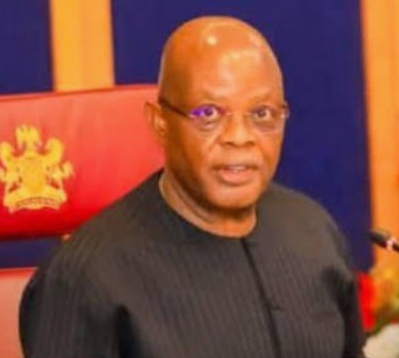
The political climate in Rivers State of Nigeria, continues to raise serious constitutional questions following the controversial actions of the state’s Sole Administrator, Retired Vice Admiral Ibok-Ete Ibas.
Since the suspension of Governor Siminalayi Fubara by President Bola Ahmed Tinubu, Rivers State has been without elected commissioners, raising concerns about the legality and propriety of governance in the oil-rich state.
Following his appointment, Vice Admiral Ibas announced he would run the affairs of the state with Permanent Secretaries, making only a few critical appointments, including the Secretary to the State Government and his Chief of Staff.
However, developments took a dramatic turn when he proceeded to appoint administrators for the 23 local government areas across the state.
This move has sparked widespread criticism and legal opposition, especially given an existing court order from the Federal High Court in Port Harcourt, which explicitly barred the Sole Administrator from making such appointments.
According to a statement issued by the Secretary to the State Government, Professor Ibibia Worika, these appointments took effect on Monday, April 7, 2025.
The Federal High Court order was delivered by Justice Adamu Turaki Muhammed in response to a suit filed by a civic group, the PILEX Centre for Civic Education Initiative, challenging the legality of Ibas’s actions.
Despite this, the Sole Administrator also went ahead to appoint the Chairman and members of the Rivers State Independent Electoral Commission, tasked with conducting local government elections.
Prominent legal practitioner and political analyst, Liborous Oshoma, strongly condemned the actions of the Sole Administrator, describing them as unconstitutional and a flagrant abuse of democratic principles.
According to Oshoma, the role of a Sole Administrator is meant to be a temporary peacekeeping measure—not a substitute for elected governance.
He stated that the appointments of caretaker committees and electoral bodies without due democratic processes undermine the rule of law and contradict existing Supreme Court rulings that had previously barred allocations to Rivers State until properly conducted elections are held.
Oshoma noted, “In a country that claims to have fought to dismantle military rule, only to now introduce it through the back door under a democratic guise, the legality of these actions is highly questionable.
The courts must give a clear interpretation of Section 305 of the Constitution to address this crisis.”
The legality of President Tinubu’s declaration of a state of emergency in Rivers State on March 18, 2025—which led to the suspension of Governor Fubara, his deputy, and members of the State House of Assembly—is now the subject of a major legal battle.
The Federal High Court in Port Harcourt is set to commence hearing on May 21, 2025, on a suit filed by Belema Briggs and others.
The plaintiffs are challenging the President’s authority under the 1999 Constitution (as amended), specifically referencing Sections 1, 4, 5, 11, 180, 188, and 305.
They seek judicial clarity on whether the President has the constitutional powers to suspend a duly elected executive, which is guaranteed a four-year term under the Constitution.
The suit also questions whether the National Assembly possesses the legal right to ratify such a proclamation that effectively dissolves the state executive arm.
In addition to this, eleven serving governors under the opposition People’s Democratic Party (PDP) have approached the Supreme Court, urging it to rule on the constitutionality of the President’s actions and restore democratic order in Rivers State.
The unfolding political crisis in Rivers State remains a litmus test for Nigeria’s democratic institutions.
The legal community and civil society organizations are calling for swift judicial intervention to prevent further erosion of constitutional governance.
The coming weeks will be crucial in determining whether the rule of law will prevail or if executive overreach will continue unchecked in one of Nigeria’s most economically vital states.