Imo Charter of Equity Beyond Sentiments: Rethinking Equity, Justice Ahead of 2027

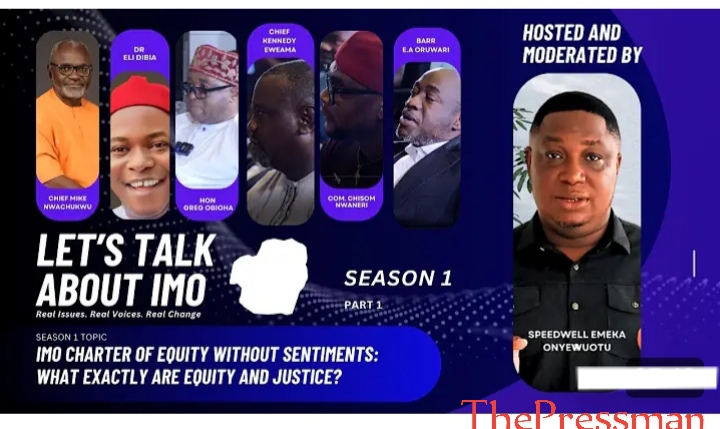
In a compelling new civic engagement series titled “Let’s Talk About Imo,” a thought-provoking conversation has emerged under the theme: “Imo Charter of Equity Without Sentiments: What Exactly Are Equity and Justice?”
The inaugural episode of Season 1, Part 1, has ignited widespread public interest as it delves into the profound meanings of equity and justice within Imo State’s socio-political framework.
This groundbreaking dialogue comes at a time when many Imolites are increasingly demanding a governance structure rooted in fairness, inclusiveness, and transparency—devoid of bias, ethnic sentiments, or political manipulation.
Citizens across the state are calling for a system that truly reflects the ideals of justice and equitable representation.
The session featured an impressive panel of thought leaders and intellectuals who provided honest reflections and deep insights into the topic.
Dr. Eli Dibia, a renowned political analyst from the Okigwe Zone, delivered a foundational perspective on the philosophical and practical implications of equity and justice.
His discourse laid the groundwork for an informed and meaningful discussion.
Chief Kennedy Eweama, a respected former Chief Press Secretary (CPS) to a highly revered traditional ruler in Imo State, as well as a seasoned journalist and influential voice in public discourse, traced the historical evolution of the Imo Charter of Equity.
He offered a critical analysis of its achievements and the inconsistencies in its implementation over time.
Barrister E.A. Oruwari, a reputable legal practitioner and staunch advocate of inclusive governance, passionately called for the honest application of the Charter.
He emphasized the need for regional balance, legal integrity, and the eradication of mere lip service in the governance process.
The conversation was expertly moderated by Chief Mike Nwachukwu (Mpidike), a technocrat and civic engagement advocate from the Owerri Zone.
His role as moderator ensured that all voices were heard during the vibrant social media broadcast of the event.
Also contributing valuable insights was Hon. Greg Obioha, who examined the Charter from a legislative perspective.
He proposed a thorough review of the document to align it with contemporary political realities and the aspirations of the people of Imo State.
Comrade Chisom Nwaneri, a vibrant youth advocate, brought in the perspective of the younger generation.
He called on the youths to support the cause of justice and stressed that any meaningful discussion on equity must also include deliberate plans for youth leadership and developmental opportunities.
A defining moment in the discourse came with the bold contribution of Mr. Speedwell Emeka Onyewuotu, whose candid observations cut through political correctness.
He remarked, “Equity without truth is compromise, and justice without courage is failure.”
His powerful viewpoint challenged the audience to rethink governance as a moral responsibility rather than a mere game of rotational politics.
The conversation reflected not only a rich exchange of ideas but also a growing public yearning for transformative leadership—one anchored on justice and true equity—as the state prepares for the 2027 gubernatorial elections.
As the “Let’s Talk About Imo” series continues, many stakeholders are optimistic that it could evolve into a powerful civic platform capable of influencing political decisions and leadership directions within the state.
However, one lingering question remains: Can dialogues like these inspire real policy reform, or will they once again be drowned by the familiar tide of political expediency?
Only time—and sustained civic participation—will provide the answer.
ThePressman Newspaper, which closely monitored the conversation via social media, commended the organizers for this timely and impactful initiative.
The publication further called on all citizens of Imo State to uphold the principles of equity and justice as they prepare to elect their leaders in the 2027 polls.
ThePressman also observed that several participants in the discussion revisited the origins and progression of the Imo Charter of Equity.
According to them, the Charter began in 1999 with Chief Achike Udenwa from Orlu Zone, who governed for eight years.
They further noted that following Udenwa’s tenure, Orlu Zone continued to dominate the governorship through Senator Rochas Okorocha and the incumbent, Senator Hope Uzodinma.
This cumulative leadership, they argued, amounts to 24 years under the control of Orlu Zone.
This perceived political imbalance prompted questions of fairness and justice.
Consequently, many discussants strongly advocated that, in the interest of equity and inclusiveness, the next governor of Imo State in 2027 should come from either the Owerri Zone or the Okigwe Zone.
They emphasized the urgent need for political unity between the two zones and called on their leaders and stakeholders to begin early consultations and alliances in preparation for 2027.
In a rather symbolic proposal, participants in the discussion urged prominent figures such as the retired Archbishop A.J.V. Obinna of the Owerri Catholic Diocese, former Senator representing Owerri Zone, Senator Chris Anyanwu, and Rev. Fr. Gerald Njoku, to extend apologies to the people of Okigwe Zone and to former Governor Ikedi Ohakim.
This gesture, they noted, would serve as a step toward reconciliation and healing between both zones.
Further contributing to the conversation, an unnamed discussant advised that Sir Martin Agbaso and Sir Ikedi Ohakim should engage in a private meeting to resolve their past political differences, particularly relating to events that occurred in 2007 and 2011.
The discussant emphasized that such reconciliation would strengthen the chances of a united front between the two zones.
In conclusion, the call for unity between the Owerri and Okigwe Zones was reiterated with a strong appeal for both regions to set aside historical grievances and come to a roundtable discussion focused on peace, forgiveness, and strategic collaboration.
This, they asserted, is the only viable path toward producing a governor from either zone come 2027.
By Dan Opara (Danjay)
ThePressman Newspaper
Political Analyst / Journalist
07030811559.