By Dan Opara
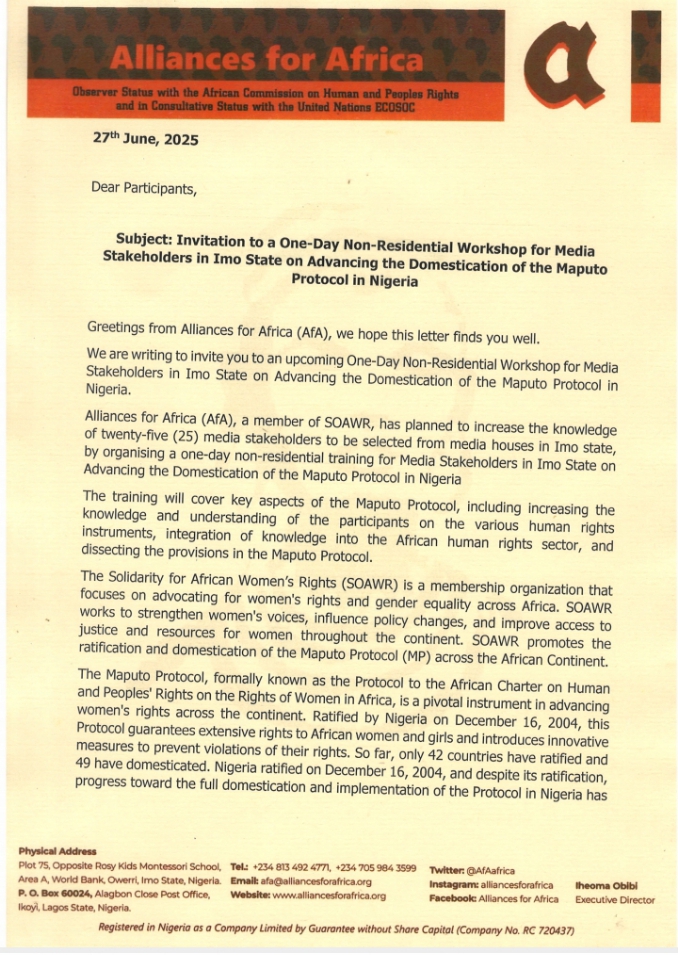
In a renewed effort to promote the domestication of the Maputo Protocol in Nigeria, Alliances for Africa (AfA), in collaboration with the Solidarity for African Women’s Rights (SOAWR), is set to host a one-day non-residential capacity-building workshop for media stakeholders in Imo State on Monday, June 30, 2025.
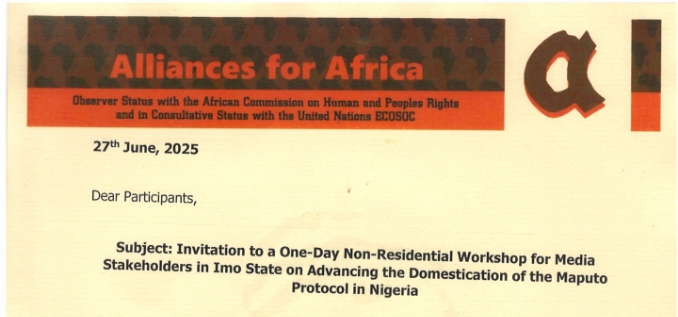
ThePressman Newspaper (Online) gathered that the event will take place at the prestigious Rockview Hotel, Owerri, and will bring together twenty-five (25) carefully selected journalists and media professionals from various media houses across the state.
The primary objective is to deepen their understanding of the Maputo Protocol and other key African human rights instruments, with a particular focus on women’s rights and gender equality.
According to AfA, the training will cover key thematic areas such as human rights advocacy, gender-sensitive reporting, and an in-depth analysis of the provisions contained in the Maputo Protocol.
Participants will be equipped with tools and strategies to effectively advocate for, report on, and drive public awareness on the need for full domestication and implementation of the Protocol in Nigeria.
The Executive Director of Alliances for Africa, Ms.Iheoma Obibi, based on the Media Invitation, emphasized that the workshop forms part of SOAWR’s broader continental mission to amplify women’s voices, influence policy reforms, and strengthen women’s access to justice across Africa.
The Maputo Protocol, officially known as the Protocol to the African Charter on Human and Peoples’ Rights on the Rights of Women in Africa, was ratified by Nigeria on December 16, 2004.
However, despite this ratification, the country is yet to fully domesticate and implement its provisions.
AfA expressed optimism that with increased media engagement and strategic reporting, stronger public pressure and government action will be mobilized towards achieving the full realization of the Protocol’s objectives in Nigeria.
Meanwhile, the domestication of the Maputo Protocol involves incorporating the African Union’s 2003 Women’s Rights Treaty into Nigeria’s national laws.
Though Nigeria signed and ratified the protocol in 2004, it remains unenforceable without domestication.
The protocol addresses key issues like gender equality, violence against women, reproductive health rights, political participation, and protection from harmful practices.
Advocacy groups like Alliances for Africa (AfA) are pushing for legislative action.
Challenges include cultural resistance, legislative delays, and misconceptions about certain clauses.
Domestication is essential to legally protect women and girls in Nigeria, ensuring their rights are upheld and enforceable under Nigerian law.