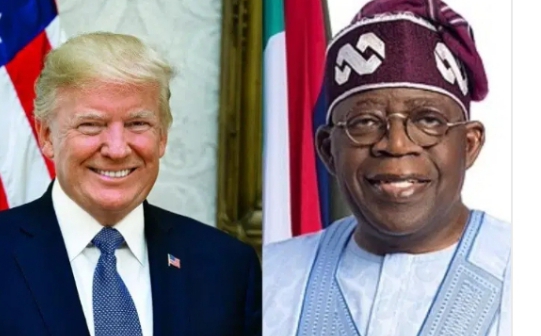
US President, Donald Trump Threatens Military Action in Nigeria Over Alleged Killings of Christians

By Dan Opara
Diplomatic relations between the United States of America, USA, and Nigeria took a sharp turn this week after when the President of America, Donald Trump issued a strong warning that Washington-USA may launch military operations in Nigeria in response to what he described as the “mass killing of Christians.”
In a post on his Truth Social platform, Trump accused the Nigerian government of neglecting to stop attacks on Christians allegedly carried out by “Islamic terrorists.”
He said he had instructed the United States Department of Defense (Pentagon) to begin preparing for possible intervention if the situation continued.
“If the Nigerian Government continues to allow the killing of Christians, the U.S.A. will immediately stop all aid and assistance to Nigeria, and may very well go into that now-disgraced country, ‘guns-a-blazing,’ to completely wipe out the Islamic Terrorists who are committing these horrible atrocities,” Trump declared.
“I am hereby instructing our Department of War [sic] to prepare for possible action. If we attack, it will be fast, vicious, and sweet, just like the terrorist thugs attack our cherished Christians!”
He further stated that U.S. aid to Nigeria would be immediately suspended unless the alleged killings were halted.
Reacting to Trump’s remarks, President Bola Ahmed Tinubu swiftly rejected the accusations, describing the threat as “misguided and unfounded.”
He reaffirmed Nigeria’s commitment to religious freedom, unity, and tolerance, and insisted that foreign interference in the country’s internal affairs would not be accepted.
According to the Nigerian Ministry of Foreign Affairs, the government urged the U.S. to provide genuine support in tackling violent extremists instead of issuing threat-laden designations or considering military interventions.
Observers have described Trump’s rhetoric — referencing “guns-a-blazing” deployments and direct military intervention — as a major escalation in U.S.–Nigeria relations.
Analysts caution that Nigeria’s security challenges are complex, noting that violent attacks in the country affect both Christians and Muslims and often stem from a mixture of religious extremism, ethnic and communal tensions, resource conflicts, and insurgency.
Nigeria, Africa’s most populous country, has a roughly equal Christian–Muslim demographic split.
The U.S. government has reportedly re-added Nigeria to its “Countries of Particular Concern” list for alleged religious freedom violations — a designation that carries significant diplomatic and legal implications.
While Trump’s directive to the Pentagon has not yet resulted in any confirmed action, reports suggest that preliminary planning discussions are underway.
Analysts warn that an actual deployment of U.S. forces would mark a drastic and unprecedented move in U.S. foreign policy.
The threatened suspension of American aid could also affect joint efforts between both nations in security, counter-terrorism, and development.
Nigeria’s government is expected to push back diplomatically and may engage with international partners to resist external pressure or potential intervention.
Meanwhile, global observers fear that any foreign military involvement in Nigeria could inflame domestic tensions and further deepen religious and regional divides within the country.