By Dan Opara
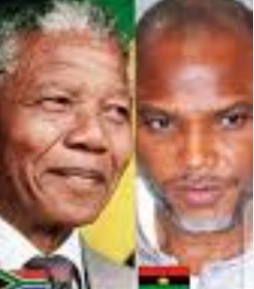
As debates over self-determination continue to shape global political discourse, comparisons have emerged between Nelson Mandela, the late South African anti-apartheid icon, and Nnamdi Kanu, leader of the Indigenous People of Biafra (IPOB) in Nigeria.
While supporters of both figures highlight their roles as symbols of resistance, a closer examination reveals significant differences in context, methods, and outcomes.
Nelson Mandela, a South African national, led the struggle against apartheid from the 1940s to the 1990s.
He served as the leader of the African National Congress (ANC) and spent 27 years imprisoned for his activism before becoming South Africa’s first Black president.
Mandela’s movement emphasized racial equality, human rights, and nation-building, combining peaceful protest with, at times, armed resistance.
Nnamdi Kanu, a Nigerian of Igbo origin, has led IPOB since the 2010s, advocating for Biafra’s independence.
His activism is primarily conducted through media engagement and public mobilization.
Kanu has been detained multiple times by Nigerian authorities under terrorism-related charges.
His struggle focuses on self-determination for the Igbo people, though the movement remains politically sensitive and unresolved.
Mandela’s approach balanced negotiation with strategic resistance, ultimately leading to the dismantling of apartheid.
His leadership earned him international acclaim, including the Nobel Peace Prize in 1993, and cemented his legacy as a global symbol of freedom.
In contrast, Kanu’s methods rely heavily on media, speeches, and advocacy.
While he is celebrated among Biafra supporters as a freedom fighter, he has limited recognition on the global stage compared to Mandela.
Both Mandela and Kanu are seen as figures who resisted oppression, emphasized self-determination, and endured detention due to their activism.
However, Mandela’s struggle resulted in national reconciliation and lasting political change, whereas Kanu’s campaign remains unresolved.
Additionally, Mandela fought against racial injustice in South Africa, while Kanu’s struggle is rooted in ethnic self-determination in Nigeria.
Supporters often liken Nnamdi Kanu to Mandela because of their shared narratives of resistance, yet the historical, political, and social contexts of their struggles are vastly different.
Mandela achieved global recognition and peaceful national transformation, while Kanu’s movement continues amid complex legal and political challenges.
Nelson Mandela and Nnamdi Kanu are often compared as symbols of resistance, but their stories diverge significantly.
Mandela, South Africa’s anti-apartheid hero, fought racial oppression from the 1940s to the 1990s, endured 27 years in prison, and later became the country’s first Black president.
He earned global recognition, including the Nobel Peace Prize, and left a legacy of democracy, reconciliation, and nation-building.
Mazi Kanu, leader of IPOB in Nigeria, advocates for Biafra’s independence and freedom through media and activism.
Detained multiple times, his struggle remains unresolved, with limited global recognition, though he is celebrated among supporters for defending Igbo self-determination from Nigeria.
Ultimately, both are viewed as fighters for freedom, yet Mandela achieved lasting political change, while Kanu’s movement is still ongoing.
Now that he is in prison, the question remains whether he might one day become president of a country.
The contexts, methods, and outcomes of their struggles could not be more different, yet their courage and determination are strikingly similar.
Personally, I envision Mazi Nnamdi Kanu walking out of prison.
God Almighty is capable of all things for humanity. Perhaps, through a presidential pardon, his freedom could be restored.
Though he is currently serving a life sentence at the Sokoto State Prison, but God is able to set him free.
In the eyes of the law, he is already on the path to the Appeal Court through his legal team.
God is able!!! He is able…