By ThePressman Newspaper
Abuja, Friday, December 19, 2025
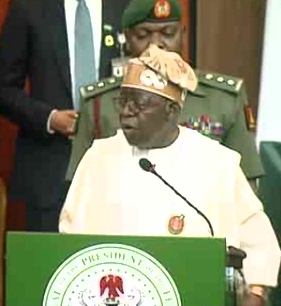
President Bola Ahmed Tinubu on Friday presented the ₦58.18 trillion 2026 Appropriation Bill to a joint session of the National Assembly, declaring that the 2026 fiscal year will usher in a new era of stronger discipline, accountability, and results-driven budget execution.
The proposed budget, titled “Budget of Consolidation, Renewed Resilience and Shared Prosperity,” is designed to consolidate recent economic reforms and convert stabilising macroeconomic indicators into tangible improvements in the living standards of Nigerians.
End to Multiple Budgets and Fiscal Overlaps
President Tinubu announced the termination of the long-standing practice of running multiple overlapping budgets, which he said has encouraged abandoned projects, rising contractual liabilities, and weak fiscal discipline.
Describing the move as a decisive reset, the President declared that by March 31, 2026, all outstanding capital liabilities from previous years would be fully funded and closed.
“From April, Nigeria will operate on a single budget backed by a single revenue cycle—no overlaps, no excuses, no rollovers,” he stated.
Budget Implementation and Revenue Performance
Reviewing the implementation of the 2025 budget, President Tinubu noted that as of the third quarter of 2025, the Federal Government recorded ₦18.6 trillion in revenue, representing 61 per cent of the target, while ₦24.66 trillion was spent, amounting to 60 per cent of projected expenditure.
He explained that the extension of the 2024 capital budget to December 2025 necessitated the release of ₦2.23 trillion for 2024 capital projects by June 2025, while only ₦3.10 trillion, about 17.7 per cent of the 2025 capital budget, was released as of Q3.
The President, however, assured that 2026 would mark a clear departure from past practices, with strict adherence to budget timelines and appropriations.
Directives for Stronger Accountability
To ensure compliance, President Tinubu said he had issued firm directives to the Minister of Finance and Coordinating Minister of the Economy, the Minister of Budget and Economic Planning, the Accountant General of the Federation, and the Director General of the Budget Office to strictly implement the 2026 budget as approved.
He expressed optimism that revenue performance would improve through the new National Tax Acts and ongoing reforms in the oil and gas sector, aimed at transparency, efficiency, and long-term fiscal sustainability.
Warning to Government-Owned Enterprises
The President issued a stern warning to Government-Owned Enterprises (GOEs) and revenue-generating agencies, declaring that underperformance would no longer be tolerated.
He announced plans for full digitisation of revenue mobilisation, including standardised electronic collections, automated reconciliation, data-driven risk profiling, and real-time performance dashboards to block leakages and enhance compliance.
Economic Outlook and Key Indicators
Highlighting recent economic progress, President Tinubu disclosed that Nigeria’s economy grew by 3.98 per cent in Q3 2025, compared to 3.86 per cent in the same period of 2024.
Inflation, he said, had moderated for eight consecutive months, dropping to 14.45 per cent in November 2025 from 24.23 per cent in March.
He also cited improved oil production, expanded non-oil revenues, rising investor confidence, and external reserves hitting a seven-year high of approximately US$47 billion.
2026 Fiscal Framework
The 2026 budget proposes total expenditure of ₦58.18 trillion against projected revenue of ₦34.33 trillion. Capital expenditure is estimated at ₦26.08 trillion, while recurrent non-debt spending stands at ₦15.25 trillion.
Debt servicing is projected at ₦15.52 trillion, with a budget deficit of ₦23.85 trillion, representing 4.28 per cent of GDP.
The budget assumptions include a crude oil benchmark of US$64.85 per barrel, daily oil production of 1.84 million barrels, and an exchange rate of ₦1,400 per US dollar.
Priority Sectors and Allocations
President Tinubu identified security, infrastructure, education, health, and agriculture as top priorities in the 2026 budget.
Proposed allocations include:
₦5.41 trillion for defence and security
₦3.56 trillion for infrastructure
₦3.52 trillion for education
₦2.48 trillion for health.
He stressed that these sectors are interdependent, noting that security is fundamental to investment and development.
New Counter-Terrorism Doctrine
On national security, the President announced the establishment of a new national counter-terrorism doctrine aimed at decisively tackling terrorism, banditry, kidnapping, and violent crimes.
Under the new framework, all armed groups operating outside state authority will be classified as terrorists, with unified command and intelligence-driven operations guiding enforcement.
Health, Infrastructure, and Food Security
President Tinubu welcomed over US$500 million in health-sector grants secured from the United States, describing the support as a vote of confidence in Nigeria’s reform agenda.
He reaffirmed commitments to healthcare delivery, infrastructure development, agricultural mechanisation, irrigation, storage, and agro-value chains to boost food security and economic resilience.
Assurance to Nigerians
Commending Nigerians for their patience and resilience, President Tinubu assured that the benefits of ongoing reforms would reach households and communities nationwide.
“The greatest budget is not the one we announce; it is the one we deliver,” he said.
Bayo Onanuga
Special Adviser to the President (Information & Strategy)
December 19, 2025.