By Dan Opara
Nigeria operates a federal system comprising 36 states, each governed by an elected executive governor who serves as the chief executive of the state.
The Federal Capital Territory (FCT), Abuja, remains an exception, being administered by a minister appointed by the President.
In each state, the deputy governor constitutionally stands as the first in the line of succession in the event of a vacancy.
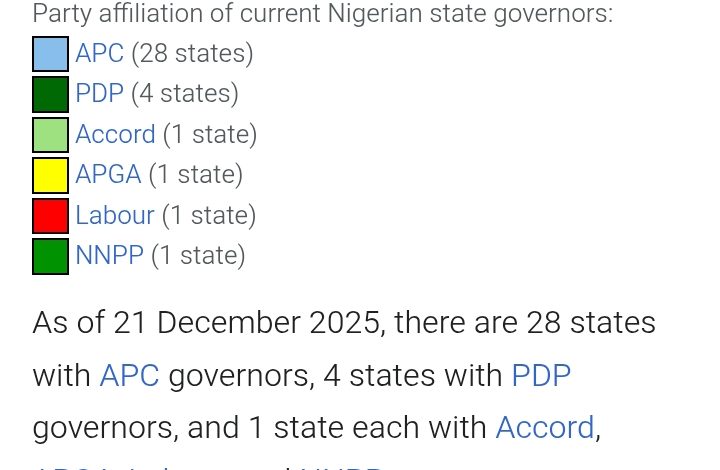
As of December 21, 2025, the current partisan control of Nigeria’s states reflects a strong numerical advantage for the ruling All Progressives Congress (APC).
The APC controls 29 states, while the Peoples Democratic Party (PDP) governs three states.
The remaining states are controlled by Accord, APGA, the Labour Party (LP), and the New Nigeria Peoples Party (NNPP), with one state each.
Governors in Nigeria are elected for a four-year term and may serve a maximum of two terms.
For most states, gubernatorial tenures expire in May, shortly after elections conducted earlier in the year.
All 36 governors are members of the Nigeria Governors’ Forum (NGF), a non-partisan body that facilitates dialogue between states and the federal government.
There are also partisan platforms such as the Progressive Governors’ Forum and the PDP Governors’ Forum, which reflect party-based interests.
Ahead of the 2027 general election, the increasing wave of defections to the APC, particularly by governors originally elected on opposition platforms, has fueled intense political debate.
While the ruling party’s control of 29 states appears formidable on paper, political analysts caution against interpreting this dominance as an automatic pathway to President Bola Ahmed Tinubu’s re-election.
Notably, a significant number of governors now flying the APC flag secured their electoral victories under opposition parties, relying on voter goodwill, local political structures, and regional dynamics that were not originally built by the APC.
Analysts argue that such defections are often driven by personal survival, strategic calculations, and access to federal influence, rather than genuine ideological alignment.
Observers further warn that political loyalty rooted in convenience can be fragile.
Should personal or group interests clash with party expectations, the same actors could undermine internal cohesion or even switch allegiances once again, thereby weakening the party’s electoral machinery.
Ultimately, analysts emphasize that electoral outcomes are determined by governance performance, public perception, economic realities, and voter confidence, not merely by the number of governors aligned with a ruling party.
As 2027 approaches, Nigerians are expected to judge the Tinubu administration less by defections and more by tangible results that impact their daily lives.
In this context, the growing dominance of the APC at the state level may shape political calculations, but it does not, by itself, guarantee victory at the polls.