Uzodimma Presents ₦1.44 Trillion 2026 Budget of Economic Breakthrough to IMHA Members

By Dan Opara
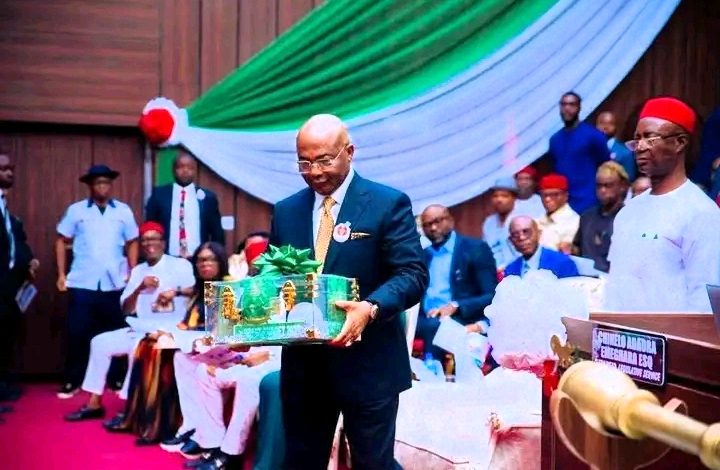
The Shared Prosperity Executive Governor of Imo State, Senator Dr. GoodHope Odidika Uzodimma (Onwa Oyoko), on Monday, December 22, 2025, made history with the presentation of a ₦1,439,573,590,405.04, approximately ₦1.44 trillion, Appropriation Bill for the 2026 fiscal year to members of the Imo State House of Assembly, IMHA.
The proposal represents the first trillion naira budget in the history of Imo State.
Christened the Budget of Economic Breakthrough, the draft estimates of ₦1,439,573,590,405.04 (one trillion, four hundred and thirty nine billion, five hundred and seventy three million, five hundred and ninety thousand, four hundred and five naira, four kobo), are targeted at consolidating infrastructure development and deepening the impact of key economic programmes of the administration.
The budget is designed to promote economic independence and sustainable growth across the State.
During the presentation, Governor Uzodimma explained that the estimates prioritise synergy among flagship initiatives such as the Light Up Imo Project, the Orashi Free Trade Zone, expansion of the Sam Mbakwe International Cargo Airport, and the Digital Economy agenda.
He noted that these initiatives are geared toward job creation, economic transformation, and improved living standards for the people of Imo State.
Presenting the proposal at the Assembly Complex, the Governor reaffirmed his administration’s commitment to transparency and accountability, stating that the 2026 budget builds on measurable achievements recorded over the past six years.
He cited the completion of over 130 roads, the establishment of six functional tertiary hospitals, and notable improvements in security across the State.
Governor Uzodimma disclosed that the 2026 budget represents a 78 percent increase over the 2025 fiscal year.
A detailed breakdown shows that ₦1.201 trillion, representing 83.4 percent, is allocated to capital expenditure, while ₦238.5 billion, or 16.6 percent, is earmarked for recurrent expenditure to cover personnel costs, overheads, and statutory obligations.
On the revenue side, the State projects ₦823.27 billion from recurrent revenue sources, including Internally Generated Revenue, statutory allocations from the Federation Account, Value Added Tax, derivation funds, and other federal transfers.
Capital receipts from development partners and donor agencies are estimated at ₦382.72 billion.
Capital expenditure is largely directed toward economic and social development.
The economic sector receives over ₦1.01 trillion, followed by the social sector with ₦87.7 billion, administrative services with ₦32.8 billion, as well as special intervention votes.
Strategic ministries also received substantial allocations in line with government priorities.
The health sector emerged as the highest beneficiary, with funding targeted at rehabilitating health facilities and expanding access to quality healthcare services.
Significant allocations were also made to works and infrastructure, power, education, agriculture, rural development, entrepreneurship, and skills acquisition to stimulate employment and inclusive growth.
Describing the budget as a roadmap to sustained economic breakthroughs, Governor Uzodimma assured lawmakers that all ongoing projects would be completed and that the proposed investments would translate into tangible benefits for the people of Imo State.
He pledged that no project would be abandoned, stressing that the budget provides a solid foundation for industrialisation, economic stability, and shared prosperity.
In his welcome address, the Speaker of the Imo State House of Assembly, Rt. Hon. Chike Olemgbe, commended the Uzodimma administration for what he described as impactful and forward looking governance.
He emphasised the need for cooperation among the arms of government and reaffirmed the legislature’s commitment to democratic principles.
Rt. Hon. Olemgbe highlighted key achievements of the 3R Administration, including improved security, the establishment of the Imo State Electricity Regulatory Commission, prompt payment of civil servants’ salaries, and the recruitment of over 6,000 teachers.
He also praised ongoing infrastructure projects, particularly extensive road construction and improvements at the Sam Mbakwe International Cargo Airport.
He further acknowledged progress in the digital economy, citing the creation of a dedicated ministry that has enhanced efficiency in governance and service delivery.
Referring to the recent Imo Economic Summit, he described it as a significant boost to the State’s investment prospects.
In their separate remarks, lawmakers representing Orsu, Oguta, Oru East, Owerri Municipal, and Isiala Mbano constituencies, Hon. Uche Agabige, Hon. Gilbert Nwosu, Hon. Chigozie Nwaneri, Hon. Clinton Amadi, and Hon. Sam Osuji, expressed satisfaction with the 2026 budget proposal.
They described it as ambitious and people oriented, while pledging accelerated legislative consideration.
Delivering the vote of thanks, the Deputy Speaker, Rt. Hon. Amara Iwuanyanwu, applauded the Governor for the achievements recorded under his leadership.
He attributed the successes to the harmonious relationship between the executive and legislative arms of government and assured the Governor of the Assembly’s continued partnership in advancing the collective interest of Imo State.
The Majority Leader of the House, Rt. Hon. Chief Kanayo Onyemaechi, representing Owerri West State Constituency, also expressed appreciation to the Governor and assured him of the continued support of the House toward the successful implementation of the 2026 Budget.