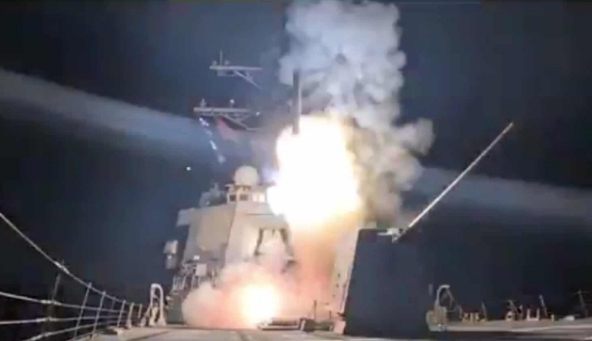
On December 25, United States President Donald Trump announced that he had ordered American military strikes against Islamic State targets in northwestern Nigeria, Sokoto State precisely.
The action, he said, was in retaliation for the group’s persistent attacks on Christian communities across the country.
The United States Africa Command, AFRICOM, later confirmed that the strikes occurred in Sokoto State, which borders the Sahelian nation of Niger.
In a statement posted on Truth Social, President Trump said that, acting in his capacity as Commander in Chief, the United States carried out what he described as a powerful and deadly strike against Islamic State terrorists operating in northwest Nigeria.
He accused the group of targeting and brutally killing innocent Christians at levels not seen for many years. US officials have also indicated that additional strikes have not been ruled out.
While jihadist groups in Nigeria have deliberately targeted Christians because of their faith, analysts note that they also frequently kill moderate Muslims.
Since 2009, Nigeria’s military has borne the brunt of sustained jihadist violence, suffering significant casualties in its prolonged campaign against insurgent groups.
President Trump’s initial statement did not specify the precise location of the operation.
AFRICOM did not disclose the number of strikes conducted or provide a detailed damage assessment, stating only that the operation resulted in the deaths of multiple terrorists.
According to reports, the strikes involved Tomahawk cruise missiles launched from a United States Navy vessel.
The Nigerian government has since confirmed the bombings, noting that they were carried out as part of a cooperative effort between Nigeria and the United States.
Sokoto State shares a border with Niger and has increasingly become a frontline in the expansion of jihadist groups from the Sahel into Nigeria.
In recent years, the Islamic State’s Sahel Province, which is primarily active in Mali, Burkina Faso, and Niger, has made notable inroads into Nigerian territory through Sokoto.
Although official confirmation is lacking, it is widely believed that the recent operation targeted positions linked to this faction.
The Islamic State’s Sahel Province is only one of several jihadist organizations operating within Nigeria.
The country’s largest Islamic State affiliate is the Islamic State West Africa Province, ISWAP, which is mainly based in northeastern Nigeria but has also been expanding its reach to other regions.
ISWAP and the Sahel Province are known to maintain communication and collaboration, particularly in logistics, training, and advisory support.
Boko Haram, formally known as Jamaat Ahl al Sunnah li Dawah wal Jihad, also remains active in northeastern Nigeria.
Although independent of both the Islamic State and Al Qaeda, the group has shown signs of spreading its influence into northern and central parts of the country.
Al Qaeda likewise maintains a presence in Nigeria, especially in the northwest.
This includes factions of Jamaat Ansar al Muslimeen fi Bilad al Sudan, commonly known as Ansaru, as well as the Group for Support of Islam and Muslims, JNIM.
Like the Islamic State’s Sahel Province, JNIM is primarily based in Mali, Burkina Faso, and Niger, but has recently expanded into Nigeria.
The group claimed its first official attack in northwestern Nigeria in recent months and has since taken responsibility for additional operations in the area.
Compounding the security crisis is the presence of numerous bandit organizations across northwestern Nigeria.
Although not all of these groups are ideologically aligned with jihadists, several jihadist factions maintain links with criminal bandit networks, further fueling instability in the region.
The reported US strikes on Islamic State positions in Sokoto State highlight the complexity of Nigeria’s jihadist landscape.
They also suggest that the conflicts in the Sahel and those within Nigeria may be increasingly interconnected.
Nigeria continues to grapple with a wide range of security challenges that affect millions of citizens, extending beyond, but including, jihadist violence against Christian communities.