By Dan Opara
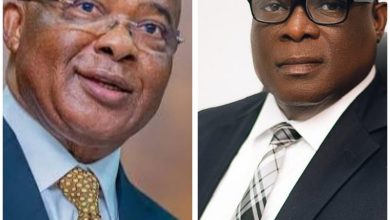
The Executive Governor of Imo State, Senator Hope Uzodimma, has reaffirmed his administration’s determination to safeguard democracy in the state, declaring that any attempt at a “hostile takeover” of political power would be firmly resisted.
He stressed that justice, inclusion, and consensus remain fundamental pillars for sustaining peace and stability in Imo State.
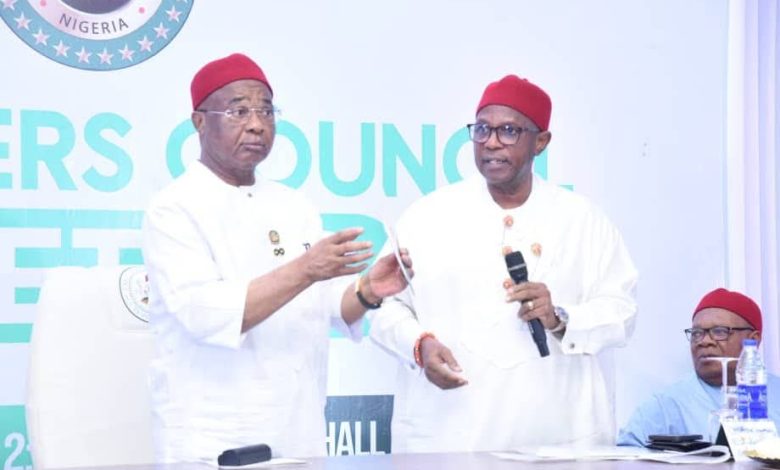
The Governor made this known on Tuesday, April 21, 2026, during a meeting with the Imo Elders Council held at the Government House Banquet Hall in Owerri.
Recalling the political crisis that ushered him into office in 2020, Uzodimma noted that exclusion and marginalization were major factors that contributed to instability at the time.
He referenced the findings of a panel led by Emeritus Catholic Archbishop Anthony Obinna, which identified marginalization as a key trigger of unrest in the state.
According to him, “Anyone denied justice may not be committed to peace. We will eliminate any type of hostile takeover by building consensus among ourselves.”
While receiving the Imo Elders Council report on the Charter of Equity, the Governor described the Council as the conscience of the state, emphasizing its statutory responsibility in guiding governance beyond individual administrations.
He further disclosed plans to amend the enabling law to strengthen the Council, including provisions that would allow sanctions against members found guilty of misconduct.
On the Charter of Equity, Uzodimma reiterated that the framework is designed to ensure fairness in the distribution of key political offices among the three senatorial zones of Okigwe, Owerri, and Orlu.
He urged political stakeholders to respect zoning arrangements and avoid actions capable of undermining unity in the state.
The Governor also reaffirmed Imo State’s alignment with the Federal Government, while acknowledging the support of President Bola Ahmed Tinubu.
He expressed optimism that adherence to equity, justice, and collective responsibility would guarantee political stability and a smooth transition of power in the state.
He stated, “The Charter of Equity has come to stay. Listen to the voice of reason, believe in the Charter, support the Federal Government, and trust in God for the rest.”
Uzodimma added that further consultations would be conducted with leaders across the three senatorial zones to deepen consensus and address longstanding political imbalances, while emphasizing that the role of the Imo Elders Council would extend beyond his administration in providing guidance to successive governments.
Earlier in his remarks, the Chairman of the Imo Elders Council, HRH Eze Cletus Ilomuanya, commended the Governor for his efforts in promoting unity across the state. He noted that sustainable development can only be achieved when all regions are given equal opportunities to thrive.
Ilomuanya further urged that the Charter of Equity should move beyond rhetoric and be implemented through equitable appointments, balanced distribution of projects, and inclusive governance.
He described it as a commitment to building a state where no region is marginalized and every citizen has a fair chance at leadership.
The meeting concluded with prayers for continued peace, unity, and progress in Imo State, alongside renewed calls for collective responsibility in advancing the state’s development agenda.
Dignitaries present included the Deputy Governor, Lady Chinyere Ekomaru and her husband, Barr. Chukwuma Ekomaru; former Deputy Governor, Lady Ada Okwuonu; the Secretary to the State Government, Chief Cosmos Iwu; members of the State Executive Council; as well as other stakeholders and opinion leaders.
The report, obtained by ThePressman Newspaper, was signed by Mr. Oguwike Nwachuku, Chief Press Secretary and Special Adviser on Media to the Governor, on Tuesday, April 21, 2026.
Meanwhile, Governor Uzodimma emphasized that political stability in Imo State depends on justice, inclusion, and respect for zoning arrangements.
He cautioned against any forceful or unfair seizure of power, advocating consensus-driven politics instead.
He further endorsed the Charter of Equity as a guiding framework for fairness, unity, and balanced leadership across the state’s three senatorial zones.