Concerned Indigenes of Okata Community Condemns Alleged One-Sided Verdict by Ihitte-Uboma Council Chairman, Prince Obioha Ndukwe, Over Land Dispute…Insists Court Judgment Remains Supreme

By Echereozo Chibuzo A.
Concerned Indigenes of Umukpabi, Odoru Village in Okata Community, Ihitte-Uboma Local Government Area of Imo State, have condemned what they described as the alleged malicious and one sided intervention of the Executive Chairman of Ihitte Uboma Local Government Area, Prince Obioha Ndukwe, in a longstanding land dispute within the community.
The community members alleged that the Council Chairman, Prince Obioha, is attempting to use his executive authority to undermine the judgment of a competent court that had already determined the matter.
They expressed concern that his actions could threaten the peace, harmony, and stability that have existed in the community since the traditional ruler delivered his verdict in line with the court’s decision.
Speaking on behalf of the community, the concerned indigenes, comprising elders, women, and youths, maintained that the chairman acted without adequately understanding the facts surrounding the dispute.
According to them, his decision contradicts the judgments already delivered by competent courts and should therefore not supersede established judicial pronouncements.
The community members stressed that the Executive Chairman, as the Chief Security Officer of the Local Government, is expected to promote peace, uphold the rule of law, and encourage reconciliation rather than take actions capable of creating tension within the community.
They urged him to respect existing court judgments and avoid actions that could destabilize the peaceful coexistence of the people.
They further stated that they fully support the position of the Traditional Ruler of Okata Community, His Royal Highness, Eze C.C. Iwueke, who, according to them, based his decision on the judgments of the courts.
They insisted that both the court’s verdict and the traditional ruler’s decision should be respected by every person involved in the dispute, irrespective of status or political influence.
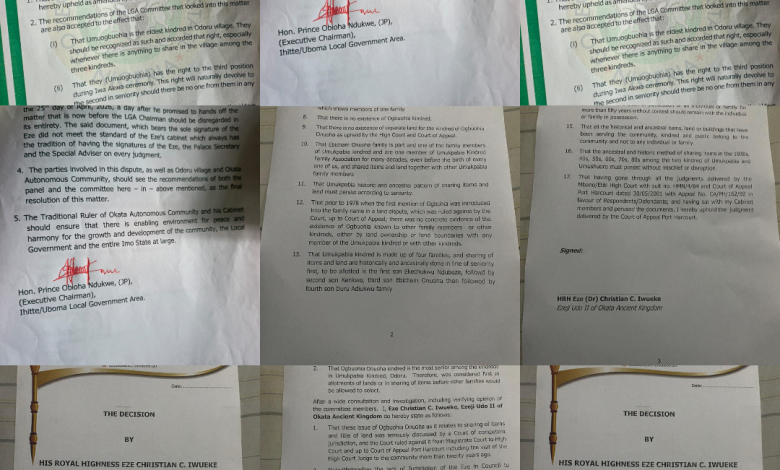
According to the community, Prince Ndukwe, in his ruling, stated that a petition dated April 21, 2026, was submitted to his office requesting an investigation into the report of a seven member fact finding committee earlier constituted by the traditional ruler.
However, the indigenes alleged that the committee deviated from its original terms of reference and produced a report that was compromised.
They further alleged that some members of the committee were influenced through gratification and failed to reflect the testimonies of three of the oldest men in Odoru Village.
According to them, the statements of the elders were omitted from the committee’s final report despite their insistence that there has never been any kindred known as “Ogbuohia” in the ancestral history or lineage of the community.
The indigenes explained that the traditional ruler subsequently rejected the committee’s report on the grounds of alleged bias, incompetence, and partiality.
Instead, he upheld the judgments previously delivered by the courts and directed that the status quo be maintained in accordance with those decisions.
They recalled that the dispute had previously been determined by both the High Court sitting in Mbano and the Court of Appeal in Port Harcourt.
According to them, Sir Humphrey Onuoha, who claimed the existence of Ogbuohia Kindred, failed to establish its identity before the courts.
They maintained that the courts ruled against his claims and awarded costs against him.
The community argued that it would have amounted to contempt of court if the traditional ruler had ignored the judicial decisions and adopted a contrary position.
They insisted that the directive to maintain the status quo simply reaffirmed the authority of the court judgments.
Providing historical background, the indigenes stated that Odoru Village consists of two ancestral families, namely Umukpabi and Umushoghoro, with Umukpabi being the elder lineage. According to them, Umukpabi had four sons, namely Ekechukwu Ndubueze, Nkwokorie Kenkwo, Ebichiem Onuoha, and Duru Adiukwu, listed in their traditional order of seniority.
They argued that there is no historical place or recognition for any lineage known as Ogbuohia within this ancestral arrangement.
According to them, Sir Humphrey Onuoha belongs to the Ebichiem Onuoha family, which occupies the third position in the established order of seniority.
The community further claimed that until 1978, the entire Onuoha family identified as members of Umukpabi Kindred.
They alleged that Sir Humphrey later attempted to establish the Ogbuohia identity in order to lay claim to disputed land but was unable to prove its existence or ancestral origin during court proceedings.
According to them, even after Sir Humphrey distanced himself from Umukpabi, his elder brother, Mr. Joel Onuoha, remained a member of Umukpabi and never adopted the Ogbuohia identity.
They also stated that throughout the litigation, Mr. Joel Onuoha neither participated in the court proceedings nor appeared in support of his younger brother’s claims.
The indigenes maintained that there is no land officially recognized as Ogbuohia land anywhere within the kindred, village, or community.
They further asserted that the courts found no evidence establishing the existence of Ogbuohia as a distinct ancestral lineage.
They expressed the belief that the Executive Chairman may not have been properly briefed on the historical facts before making his pronouncement.
They also alleged that he failed to carry out a thorough investigation and instead hurriedly reached a conclusion that appeared to favour his maternal uncle, who is one of the parties in the dispute.
The concerned indigenes cautioned that no individual should serve as a judge in a matter involving personal or family interests.
They therefore urged the chairman to withdraw from actions capable of escalating tensions and instead invite all parties for genuine dialogue based on facts and the rule of law.
They also advised those dissatisfied with the traditional ruler’s verdict to seek legal redress through the courts rather than resort to self help or administrative intervention at the Local Government Council.
The community recalled that the matter was first brought before the traditional ruler in April 2025 for arbitration and that his judgment was eventually delivered in May 2026 after almost one year of consultations, hearings, and deliberations.
They therefore dismissed claims that the traditional ruler acted hastily in reaching his decision.
According to the indigenes, since the traditional ruler communicated his judgment to all parties, the community has remained peaceful without any recorded incident of violence or unrest.
They argued that the chairman’s intervention has unnecessarily reopened a matter that had already been settled through lawful processes.
The community further alleged that a careful examination of the council chairman’s decision reveals what they described as a deliberate misrepresentation of facts designed to favour one party in the dispute.
In a related development, the indigenes also maintained that, by the customs and traditions of Okata Community, a portion of the age long traditional rite known as “Ihe Ngwutu Onu” is exclusively reserved for the eldest member of Umukpabi Kindred, namely the Ekechukwu Ndubueze family.
They appealed to Prince Obioha Ndukwe to discharge his constitutional responsibilities by promoting peace, justice, and order across all communities within Ihitte Uboma Local Government Area rather than taking actions capable of igniting avoidable conflict.
Meanwhile, as of the time of filing this report, all efforts made to reach the Executive Chairman of Ihitte Uboma Local Government Area, Prince Obioha Ndukwe, to obtain his reaction to the allegations contained in this report proved abortive. His comments were therefore unavailable at the time of publication.