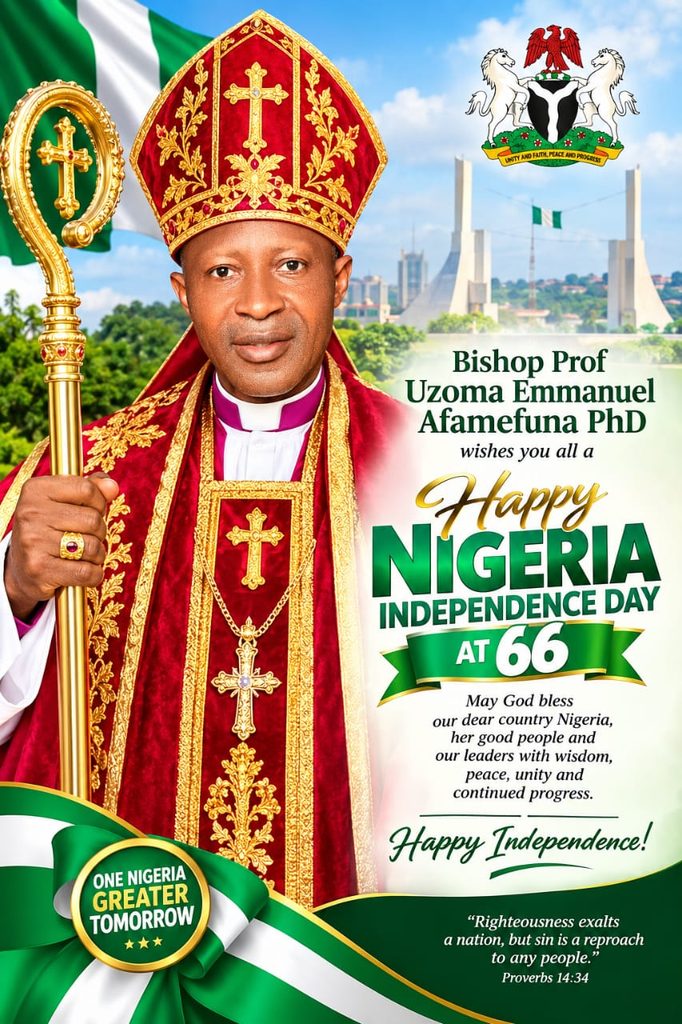
By Bishop Prof. Uzoma Emmanuel Afamefuna, PhD
President, Institute of Christian Theological Fellows, Nigeria
Introduction
Nigeria is 66 today. On 1st October, 1960, the Union Jack was lowered at the Race Course in Lagos, and the Green-White-Green flag was hoisted as Africa’s most populous nation attained political independence.
Sixty-six years later, the anniversary provides a sobering opportunity for reflection, to interrogate our journey as a nation, celebrate our resilience, confront our failures, acknowledge our achievements, and chart a credible path towards a more prosperous and united Nigeria.
The Genesis of the Nationalist Agitation
Nigeria’s independence was not granted on a platter of gold. It was the culmination of decades of nationalist agitation, driven by several historical forces.
First was the emergence of a Western educated elite. Figures such as Herbert Macaulay, Dr Nnamdi Azikiwe, Chief Obafemi Awolowo and Sir Ahmadu Bello provided intellectual and political leadership that challenged the legitimacy of colonial rule and demanded greater participation in governance.
Second were the contradictions of colonial economic exploitation. Nigeria produced groundnuts, cocoa, palm oil and, eventually, crude oil for the benefit of the British Empire, while a large proportion of the indigenous population remained economically disadvantaged and excluded from meaningful control of the country’s resources.
Third were racial discrimination and the limitations of the system of indirect rule, which restricted Nigerians’ participation in the administration of their own country.
Fourth was the impact of the Second World War. Nigerian ex servicemen who fought alongside British troops returned home with heightened political consciousness and a stronger belief that self determination was achievable.
Finally, the nationalist press played a significant role in mobilising public opinion. Newspapers, particularly Dr Nnamdi Azikiwe’s West African Pilot, helped to galvanise nationalist consciousness. The emergence of political parties such as the Nigerian National Democratic Party, NNDP, the National Council of Nigeria and the Cameroons, NCNC, the Action Group, AG, and the Northern People’s Congress, NPC, together with constitutional conferences from the Clifford Constitution of 1922 to the Lyttleton Constitution of 1954, created an increasingly powerful momentum towards self government.
What Happened on 1st October, 1960?
The formal transfer of power took place on 1st October, 1960. Princess Alexandra of Kent represented Queen Elizabeth II at the independence ceremony.
Nigeria became an independent sovereign state within the Commonwealth and operated a parliamentary system of government. Sir Abubakar Tafawa Balewa became Prime Minister and Head of Government, while Dr Nnamdi Azikiwe served as Governor General. When Nigeria became a republic in 1963, Azikiwe became the country’s first President.
The First Republic: From Hope to Collapse, 1960 to 1966
The First Republic began with considerable optimism. However, that optimism was gradually eroded by deep seated ethno regional rivalry and political crises.
The controversial census exercises of 1962 and 1963, the Western Region crisis that gave rise to the infamous “Operation Wetie”, the disputed Federal elections of 1964 and the Western Regional elections of 1965 created an atmosphere of instability and distrust.
These crises culminated in the first military coup on 15th January, 1966, led by Majors Chukwuma Kaduna Nzeogwu and Emmanuel Ifeajuna. The Prime Minister, the Premiers of the Northern and Western Regions, and several senior military officers were assassinated.
Although the coup failed to achieve its stated objectives, Major General Johnson Thomas Umunna Aguiyi Ironsi assumed power as Head of State.
Ironsi’s Unification Decree No. 34 of May 1966, which abolished the regional structure and introduced a more centralised system of administration, was widely interpreted by sections of the country as a sectional agenda. This heightened tensions and contributed to the counter coup of 29th July, 1966.
Aguiyi Ironsi and Colonel Adekunle Fajuyi were killed, while Lieutenant Colonel Yakubu Gowon emerged as Head of State.
The Civil War and Its Aftermath, 1967 to 1970
On 30th May, 1967, Lieutenant Colonel Chukwuemeka Odumegwu Ojukwu proclaimed the independent Republic of Biafra.
What followed was a 30 month civil war, fought from 6th July, 1967 to 15th January, 1970. The conflict resulted in the deaths of more than one million people, many of them from starvation and disease.
The war ended with General Yakubu Gowon’s declaration of “No Victor, No Vanquished”, a phrase that became symbolic of the Federal Government’s stated policy of reconciliation, reconstruction and rehabilitation after the conflict.
Chronology of Nigeria’s Leadership
1960 to 1966: Dr Nnamdi Azikiwe and Sir Abubakar Tafawa Balewa, First Republic
1966: Major General J. T. U. Aguiyi Ironsi
1966 to 1975: General Yakubu Gowon
1975 to 1976: General Murtala Mohammed
1976 to 1979: General Olusegun Obasanjo
1979 to 1983: Alhaji Shehu Shagari, Second Republic
1983 to 1985: Major General Muhammadu Buhari
1985 to 1993: General Ibrahim Babangida
1993: Chief Ernest Shonekan, Interim National Government
1993 to 1998: General Sani Abacha
1998 to 1999: General Abdulsalami Abubakar
1999 to 2007: Chief Olusegun Obasanjo, Fourth Republic
2007 to 2010: Alhaji Umaru Musa Yar’Adua
2010 to 2015: Dr Goodluck Ebele Jonathan
2015 to 2023: Muhammadu Buhari
2023 to date: Asiwaju Bola Ahmed Tinubu
State Creation, Infrastructure and Coups d’État
At independence in 1960, Nigeria had three regions. This increased to four regions in 1963.
In 1967, General Yakubu Gowon created 12 states. General Murtala Mohammed created seven additional states in 1976, bringing the number to 19. General Ibrahim Babangida created two states in 1987 and nine more in 1991, bringing the total to 30. In 1996, General Sani Abacha created six additional states, resulting in the 36 states that exist today.
Successive administrations have also embarked on ambitious national development programmes and infrastructure projects. These include the creation of the Federal Capital Territory in Abuja, the establishment of oil refineries, the Ajaokuta Steel Complex, federal universities, the National Youth Service Corps, NYSC, and the Niger Delta Development Commission, NDDC.
However, the persistent challenges have included inadequate policy continuity, poor maintenance culture, institutional weaknesses and inconsistent implementation.
Nigeria has also experienced several military coups and attempted coups. Successful coups occurred on 15th January, 1966, 29th July, 1966, 29th July, 1975, 13th February, 1976, 31st December, 1983, 27th August, 1985, and 17th November, 1993.
Abortive or alleged coup attempts included the Dimka coup of 1976, the Vatsa coup of 1985, the Orkar coup of 1990 and the alleged Diya coup of 1997.
The Failed State Narrative and Contemporary Realities
In international discourse, Nigeria is sometimes described as a fragile state. Such descriptions, however, do not fully capture the complexity of the Nigerian experience.
Nigeria has demonstrated remarkable resilience, possesses a vibrant private sector and has developed a globally influential creative industry. A more nuanced assessment is that Nigeria is a country facing severe institutional, economic and security pressures while also possessing enormous human and material potential.
The Ugly: Insecurity, Poverty and Electoral Integrity
Insecurity remains one of Nigeria’s most serious challenges. Boko Haram and ISWAP insurgency, banditry, mass kidnapping, farmer herder conflicts and separatist agitations have affected communities and livelihoods across different parts of the country.
Poverty remains another major concern. Nigeria’s vast natural and human resources have not translated into adequate living standards for millions of citizens. Multidimensional poverty, unemployment and underemployment continue to place significant pressure on households.
For many young Nigerians, the search for better economic opportunities has also contributed to the growing phenomenon popularly known as japa, referring to the migration of Nigerians abroad in search of improved opportunities and living conditions.
Perhaps equally damaging is the crisis of electoral credibility. Allegations and incidents involving vote buying, electoral violence, manipulation and other irregularities have contributed to public distrust and weakened confidence in the political process.
Which Way Forward? Hope Under President Tinubu?
The administration of President Bola Ahmed Tinubu assumed office in 2023 under the banner of “Renewed Hope” and introduced several major economic reforms, including the removal of the petrol subsidy, the unification of foreign exchange market arrangements, the student loan scheme and tax reforms.
These policies have generated significant debate and have also contributed to acute cost of living pressures for many Nigerians.
Their long term impact will depend on effective implementation, transparency, accountability, institutional strengthening, reduction in the cost of governance and the provision of targeted social protection for vulnerable citizens.
There is room for cautious hope, but such hope must be matched with empathy, responsible governance and policies that address the immediate realities confronting ordinary Nigerians.
What Have We Achieved at 66?
Despite our numerous challenges, Nigeria has achieved significant milestones.
We have maintained national unity despite a devastating civil war and repeated predictions of national disintegration. We have sustained democratic governance since 1999, maintained a vibrant press, built one of Africa’s largest economies and produced a globally influential youth population.
Nigeria has also achieved remarkable international recognition in entertainment, sports, literature, technology, entrepreneurship and other creative and professional fields.
These achievements demonstrate that, despite our difficulties, Nigeria possesses considerable capacity for renewal and transformation.
Admonition
To the political class: Governance is a responsibility and a sacred trust, not an avenue for primitive accumulation. Political leaders must reduce the cost of governance, strengthen democratic institutions, promote accountability and guarantee credible elections.
To religious leaders and all denominations: The pulpit and the minbar must remain instruments of moral guidance and nation building. Religious leaders should preach righteousness, unity, justice and contentment, speak truth to power and encourage their followers to contribute positively to the development of the nation.
Conclusion
Nigeria at 66 stands at a critical crossroads.
Our history is a mixture of sacrifice and achievement, hope and disappointment, progress and setbacks. The challenges before us are enormous, but so are the opportunities available to us.
The task of building a prosperous, peaceful, just and united Nigeria cannot be left to government alone. Political leaders, religious institutions, traditional rulers, professionals, the media, civil society, the private sector and ordinary citizens all have roles to play.
As Nigeria marks its 66th Independence Anniversary, we must not only celebrate where we have come from. We must honestly examine where we are, learn from our history and collectively work towards the Nigeria we desire.
Happy 66th Independence Anniversary, Nigeria.
Long live the Federal Republic of Nigeria.