By Dan Opara
From the updates on the Gabon coup on Wednesday, August 30.
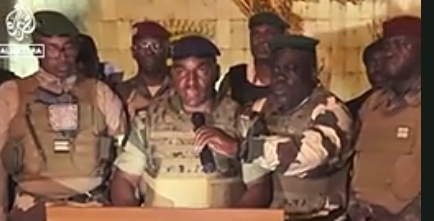
A dozen mutinous soldiers appeared on Gabonese national television, announcing the cancellation of recent election results and the dissolution of “all the institutions of the republic”.
Wednesday’s announcement came after President Ali Bongo Ondimba, 64, was re-elected for a third term, in an election the opposition described as a ‘fraud orchestrated’ by the ruling party.
The Bongo family, one of Africa’s most powerful dynasties, has been in power since 1967.
The president has confirmed he is under house arrest and called for help, urging citizens to ‘make noise’.
There have been scenes of celebration in the Gabonese capital, Libreville since the military takeover.
However, the UN Secretary-General Antonio Guterres has condemned the military takeover in Gabon following elections, his spokesman said.
Guterres “firmly condemns the ongoing coup attempt as a means to resolve the post-electoral crisis” and reaffirms “his strong opposition to military coups”, said spokesman Stephane Dujarric.
Gabon has resumed the broadcasts of several French media outlets that were suspended in the wake of a tumultuous post-election period concluding with an ongoing coup, a televised statement said.
The “temporary broadcast ban” targeted exclusively French-speaking media – France 24, RFI and TV5 Monde, which were “accused of a lack of objectivity and balance … in connection with the current general elections”.
General Brice Oligui Nguema, who has been declared transitional president, has ordered the reconnection of international radio and television channels, announced a senior officer on Gabonese TV.
Gabon’s military leaders have said that a nightly curfew in place following chaos at the end of the election process and an army takeover would remain in place until further notice.
“As of tomorrow [Thursday, August 31], Gabonese people will once again be able to freely go about their business between 6am and 6pm [05:00-17:00 GMT]. The traffic restriction remains in force from 6pm to 6am until further notice,” said a senior officer on local TV.
Germany has condemned the coup in Gabon while acknowledging there were legitimate concerns with the polls that preceded the military takeover.
“It is not up to the military to intervene by force in the political process. Gabonese people must be able to autonomously and freely decide their future,” Germany’s foreign ministry said.
Who is Brice Oligui Nguema, Gabon’s transition leader?
Nguema is one of the most influential and enigmatic figures in the country today.
He heads the Gabonese Presidency’s Republican Guard, the country’s most powerful security unit.
The son of a military officer, Nguema trained at the Royal Military Academy of Meknes, in Morocco.
The Gabon military has named General Brice Oligui Nguema as transition leader, soldiers said on national television.
Mutinous soldiers claim to have seized power in Gabon and put the president under house arrest, hours after he was declared the winner in an election that would have extended his family’s 55-year rule in the oil-rich Central African nation.
In a video apparently from detention at his residence, President Ali Bongo Ondimba called on people to “make noise” to support him. But crowds instead took to the streets of the capital and sang the national anthem.
Morocco has called for the preservation of stability in Central Africa’s Gabon, where rebel officers placed under house arrest President Ali Bongo Ondimba, a childhood friend of King Mohammed VI.
Gabon has been one of Morocco’s main allies in Africa since the reign of Mohammed’s father, Hassan II.
Morocco is “following closely the evolution of the situation in the Gabonese republic”, Rabat’s foreign ministry said in a statement.
The kingdom “underlines the importance of preserving the stability of this brotherly country and the tranquility of the population”, it added.
French mining firm Eramet has said it was resuming rail transport activities and would restart manganese operations on Thursday. Both activities have been suspended since the morning due to an ongoing coup.
“The Group is continuing to monitor the situation in Gabon closely and will keep the markets informed”, Eramet said.
Generals will meet behind closed doors to decide who should lead the transition after military officers said they seized power.
Shares in the French miner Eramet are sharply lower after it suspended all operations in Gabon during the coup.
Eramet’s mines in Gabon make it the world’s largest producer of high-grade manganese ore for steelmaking.
“In view of the events under way in Gabon and as a precautionary measure, the group has activated procedures to ensure the security of its staff and the integrity of its operations,” a spokesperson for Eramet, Gabon’s largest private employer, told Reuters.
The United States is deeply concerned by events in Gabon, where military officers said they had seized power, White House national security spokesman John Kirby told a briefing.
“We’re following this very, very closely,” he said. “It’s deeply concerning to us … we will remain a supporter of people in the region and supporter of the people in Gabon.”
Brice Nguema, suspected ringleader of Wednesday’s coup in Gabon has said the mutinous soldiers are meeting at 14:00 GMT to decide the new leader of the Central African country.
The leader of the elite Republican Guard and a relative to President Ali Bongo, was speaking in an interview to French daily Le Monde.
Nigerian President Bola Tinubu, the current chair of the Economic Community of West African States (ECOWAS), is working closely with other African heads of state on how to respond to an attempted coup in Gabon, his spokesperson Ajuri Ngelale has said.
Tinubu is watching developments in Gabon and the “autocratic contagion” spreading across the continent “with deep concern”, the spokesperson said.
A group of senior military officers in Gabon on Wednesday said they have seized power in the capital in order to overturn the results of the recent election and remove a leader whose family has held power for almost 56 years.
This came within an hour after President Ali Bongo Ondimba was announced as the winner of the presidential polls, which took place over the weekend.
Who is Brice Oligui Nguema, suspected coup leader in Gabon?
Minutes after Gabon’s electoral commission said Bongo had won a third term as president, senior military officers announced a coup and annulled the election result.
According to local media, Brice Oligui Nguema, the commander-in-chief of the Gabonese Republican Guard, the country’s most powerful security unit, is the coup ringleader.
Gabonese soldiers carry General Brice Oligui Nguema, head of the Republican Guard, as they celebrate the coup [Screenshot by Gabon 24/AFP]
The African Union’s Peace and Security Council Chair Willy Nyamitwe has said that he had urgently assembled a meeting with Burundi, Senegal, and Cameroon to analyse the situation in Gabon where a coup attempt is currently underway.
A Gabon army officer, Brice Oligui Nguema, has told the French newspaper Le Monde that generals will meet on Wednesday to decide who should lead the transition after military officers said they seized power.
The Commonwealth has voiced fears about the military coup in Gabon, which joined the bloc last year with Togo, another former French colony.
Secretary-General Patricia Scotland said the situation was “deeply concerning”, adding that the bloc was monitoring the situation closely.
“The Commonwealth Charter is clear that member states must uphold the rule of law and the principles of democracy at all times,” Scotland said.
Of the 486 attempted or successful military coups carried out globally since 1950, Africa accounts for the largest number at 214, of which at least 106 have been successful.
Based on data compiled by American researchers Jonathan M Powell and Clayton L Thyne, at least 45 of the 54 nations across the African continent have experienced at least one coup attempt since 1950.
Assala Energy says its oil production in Gabon has been unaffected by the military coup.
“We can confirm that all our personnel are safe, our operations continue as usual and our production is not affected,” a company spokesperson said.
Gabon produces about 200,000 barrels of crude oil a day, making it the second-smallest OPEC producer.
Speaking to the French newspaper Le Monde, coup leader Brice Oligui Nguema says the president will “enjoy all his rights” after the military announced it has placed him under house arrest.
“He is a Gabonese head of state. He is retired. He enjoys all his rights. He is a normal Gabonese, like everyone else,” Nguema said.
Nguema will not confirm whether he will declare himself the new president of the West African country.
“I do not declare myself yet. I do not envisage anything for the moment,” he said.
“This is a debate that we are going to have with all the generals. We will meet at 2pm [13:00 GMT]. It will be about reaching a consensus. Everyone will put forward ideas, and the best ones will be chosen as well as the name of the person who will lead the transition,” he added.
A screen grab made from a video filmed at an undisclosed shows Gabon’s deposed president, Ali Bongo Ondimba, calling on “his friends around the world to make some noise” while under house arrest [AFP]
Michaek Amoah, a senior visiting fellow at the London School of Economics, says people in former French colonies in Africa are tired of leaders clinging to power.
“This is Francophone Spring whereby the anti-French sentiment in a number of Francophone countries is now having a domino effect from Mali to Burkina Faso to Niger and now to Gabon,” Amoah said.
“If you look across the African continent at the moment, apart from Uganda and Equatorial Guinea, every single country where you find a presidential term extension, they are all Francophone. These heads of state can rule for a very long time. In Cameroon, for 41 years and counting,” he added.
At least 30 commercial ships dropped anchor around Gabon’s waters after military officers said they had seized power, Reuters news agency reported citing data and maritime sources.
British maritime security company Ambrey said port operations in Libreville had stopped and no vessels had entered or departed from the port since the announcement of the coup.
“Ambrey is aware that movements in and out of Gabon have been closed down following an early morning announcement by military officials,” it added in an advisory.
Russia has expressed concern about the situation in Gabon.
“Moscow has received with concern reports of a sharp deterioration in the internal situation in the friendly African country. We continue to closely monitor the development of the situation and hope for its speedy stabilisation,” Ministry of Foreign Affairs spokeswoman Maria Zakharova told reporters.
Kremlin spokesman Dmitry Peskov also said Moscow is closely following the situation.
Russia is looking to build up diplomatic and trade ties with Africa, and President Vladimir Putin hosted African leaders for a summit last month.
Political analyst Adama Gaye says the coup in Gabon does not come as a surprise.
“The Bongo era is over. Ali Bongo was no longer in the hearts of the population in Gabon. He was not accepted by the opposition, who were very strong this time around,” Gaye told Al Jazeera from Dusseldorf, Germany.
“There was also bickering between Ali Bongo and France to the point where, two days ago on national television, a speaker said there was a coup attempt being masterminded by Emmanuel Macron and the opposition,” he said.
“He [Bongo] was trying to create the condition for him to clamp down on the opposition and to fabricate another victory for himself in another rigged election. But this time around, the military realised that this was too far-fetched and they had to act, and that is what they did,” Gaye added.
towards Africa and now would only intervene at the invitation of says ECOWAS or any of the regional bodies or the African Union,” she added.
election body reported early on Wednesday morning that President Ali Bongo had won a third term in office.
After observing “irresponsible, unpredictable governance resulting in a continuing deterioration in social cohesion that risks leading the country into chaos… we have decided to defend peace by putting an end to the current regime”, one of the soldiers said, speaking on the Gabon 24 TV channel.